 AI All-in-One
 Ecom Tools
 Others
 AI
AI AI Audio
 AI Dev Tools
 Cloud & Storage
 Edu Tools
 Relax Tools
 Ecom Tools
Adbeat
$99.00

$99.00

Sent via customer’s email

12-24hrs

All-in-one Subscription
Adbeat provides unparalleled insights into the complex world of digital advertising. It makes perfect sense that leading companies like Box, Ancestry, and Lending Tree use Adbeat.
Official website: https://www.adbeat.com/
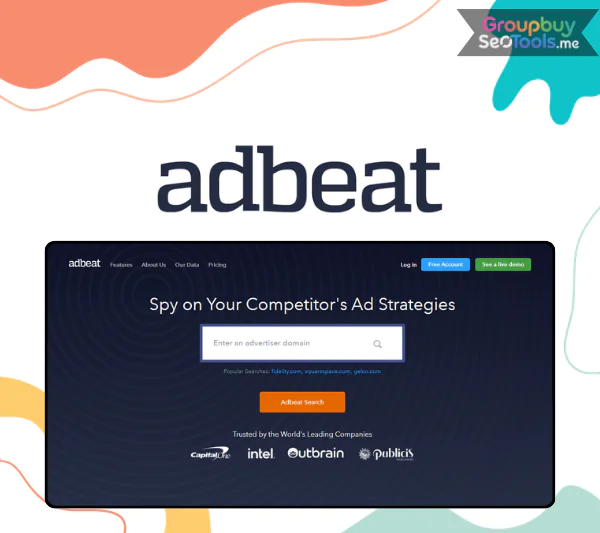 Adbeat is a competitive ad intelligence platform that lets you spy on competitors’ online ads, creatives, placements, and landing pages across multiple display and native ad networks. Despite the literal sound of the name, it is not a generic marketing term. It is a specific SaaS brand that has operated in the ad spy and competitive intelligence space for more than 10 years, tracking millions of ads across major display and native ecosystems.
The core purpose of Adbeat is simple: help advertisers, agencies, and marketers understand what is working in display and native campaigns so they can model, improve, or outcompete those strategies. In 2026, with rising CPMs, more crowded auctions, and tighter attribution, data driven ad spying has shifted from “nice to have” to table stakes for any serious media buying operation.
This guide is written for performance marketers, agencies, brands, affiliates, and media buyers who want a clear, honest answer to one question: is Adbeat the right tool for my display and native research workflow? Here is what we will cover:

Adbeat is a SaaS competitive intelligence platform focused on display and native advertising. It belongs to the broader category of ad spy tools and competitive ad intelligence platforms, alongside players that focus on social ad libraries, search advertising, mobile creatives, or affiliate marketing. Where many of those tools specialize in a single channel, Adbeat goes deep into display banners and native widgets, which is the corner of paid media where most generic spy tools fall short.
At a high level, Adbeat gives you four capabilities:
The problems Adbeat solves will feel familiar to any media buyer. Most teams waste real budget testing untested creatives. They have limited visibility into which publisher sites and placements actually convert. They lose weeks learning through trial and error what competitors already proved months ago. Adbeat compresses that learning curve by handing you a research backbone that sits inside your broader software, tools, and technology stack for performance marketing.
A quick example shows the value. A DTC brand can open Adbeat, type in a leading competitor’s domain, and see which publisher sites and which headlines that competitor uses for retargeting banners. From there, the team can prioritize the placements and creative angles already validated by someone else’s budget. Next, we will break down how Adbeat actually works in practice.
Adbeat follows a clean, repeatable workflow that turns competitor noise into research output. The full process takes minutes per session once you are familiar with the interface.
A point worth being explicit about: Adbeat only uses publicly observable ad and placement data. It does not access private advertiser accounts, real time ROAS, or actual spend numbers. What it provides is the visible layer of the market, including impressions, placements, creatives, and estimated spend modeled from observed activity. The real performance numbers still live inside each advertiser’s account, exactly as they should.
A realistic mini flow: a media buyer types in a competitor’s domain, filters to US traffic on native networks, and within seconds sees the top 20 publisher sites where that competitor spends most often. That single view often saves a week of cold publisher research. Now let us look at the features that make this workflow possible.
Adbeat’s feature set clusters into four areas: ad monitoring and competitor spying, landing page and funnel analysis, placement and network intelligence, and analytics with reporting and alerts. Each cluster focuses on a different question that media buyers and strategists ask every week.
| Feature Cluster | What You Get | Primary User Goal |
| Ad monitoring | Competitor creatives, copy, dates, rotation | Research and inspiration |
| Landing page insights | LP snapshots, funnel structure, offers | Funnel optimization |
| Placement intelligence | Publisher sites, networks, traffic sources | Media planning and whitelists |
| Analytics and reporting | Trends, charts, exports, alerts | Reporting and decision making |
The strength of Adbeat is how these clusters reinforce each other. A creative you discover ties directly to a landing page, which ties to placements, which ties to spend estimates. The deeper you go, the more your competitive map fills in.
Adbeat continuously collects display and native ads running across supported networks, including standard image banners, HTML5 creatives, native widgets, and certain programmatic placements. For each ad, you can inspect the creative format and size, the headline and body copy, the call to action, the dates the ad was first and last seen, and indicators of frequency and reach over time.
The practical benefit is obvious. Creatives running for several months across multiple publisher sites are almost certainly profitable for that advertiser. Adbeat surfaces those long running winners instantly, so you stop testing on guesswork. You also see seasonal and promotional patterns that competitors repeat year over year, which is gold for planning your own seasonal pushes. Just as importantly, the feed reveals creative iteration in real time, showing how brands evolve hooks, copy, and design across cycles.
A simple example: if a particular headline and image combination has run for months on multiple sites, it is likely profitable for that advertiser and worth modeling in your next creative brief. After creatives, most marketers want to see what is behind the click.
Adbeat lets you click straight from any ad creative through to a landing page snapshot, so you see exactly what the user sees after the impression. Beyond the first page, you can often inspect the broader funnel where it is visible, including pre sell pages, upsell sequences, and checkout layouts.
The insights you can extract are wide. You can study page layouts, hooks, social proof usage, form design, and pricing models. You can spot A/B test patterns when different landing pages run against similar creatives or offers, which gives you a window into what each advertiser is currently learning. The combination tells you which offers and angles your competitors emphasize, which shortcuts your own landing page ideation without copying their assets.
There are honest limits. Some dynamic funnels and gated content may be only partially visible, especially when personalization, IP gating, or token based access is in play. Even so, the visibility you get is dramatically better than browsing competitor sites manually. A scenario worth picturing: an affiliate sees that a competitor always sends traffic to a quiz style pre sell page before the main offer, then designs a structurally similar quiz with original branding, questions, and visuals.
Placements are the specific publisher sites, apps, or inventory slots where ads appear, and they are where Adbeat earns its keep for media planners. The platform shows the top publisher sites a given advertiser uses, the estimated volume or prominence of each placement, and the underlying network or traffic source carrying it.
The benefits compound quickly. You can build whitelists of publishers that already perform for competitors in your niche, which saves weeks of cold testing. You can avoid the publishers competitors quietly drop, which usually signals poor performance. You can also identify cross competitor patterns, where several advertisers in the same niche concentrate spend on the same 10 to 20 publisher sites.
| Network Type | Example Use | What Adbeat Shows |
| Display exchanges | Programmatic banners across the open web | Top publishers, formats, sizes |
| Native discovery | Outbrain and Taboola style native widgets | Top headlines, publisher distribution |
| Third party display networks | Standard banner inventory | Placement volume, creative rotation |
| Premium publisher direct | Direct buys on major sites | Frequency and creative lifespan |
A realistic scenario: you notice several competitors buying from the same 10 news publishers. That overlap is a very strong signal and a logical starting point for your own placement tests.
Adbeat layers analytics on top of the raw data so insight becomes communicable. You get trend charts that show estimated spend and creative volume over time, share of voice style views that compare advertisers in the same vertical, and filters by device, geo, format, and network where supported. The dashboards turn weeks of manual notes into a single screen.
Reporting options match how modern teams actually work. You can save custom views for repeated use, schedule recurring exports in PDF or CSV, and run side by side comparisons of two or three competitors. For agencies, this is the layer that turns Adbeat from a personal research tool into a client facing deliverable. A media lead can send a monthly “competitor creative trends” deck assembled almost entirely from Adbeat exports.
Adbeat’s alerting features turn passive research into active monitoring. You can be notified when competitors launch new creatives, change landing pages, or begin buying from new publisher sites, depending on the alert types your plan supports. The point is to compress the gap between “a competitor changed something” and “I responded to it.”
In practical use, this matters. When a new creative theme appears across multiple brands in your niche, you can spin up your own test before the trend is exhausted. When a competitor scales aggressively into a vertical you target, you see it early and adjust budget or messaging accordingly. The signals are external, which means they complement your internal Ads Manager data instead of duplicating it. A simple example: you receive a notification that three competitors just started running Black Friday teaser campaigns on the same two tech blogs, and your team launches its own test set the next morning. Next, we will look at who actually gets the most out of these features.
Adbeat is built for serious display and native media buyers, not for casual research. The teams that extract the most value share a profile: meaningful budgets, multi channel media plans, and a real need to understand competitor moves week by week.
Adbeat is less useful for tiny local advertisers or pure search and social spenders. If your strategy never touches display or native, the tool’s strengths simply do not apply. For everyone running serious display and native spend, the return on investment usually shows up within the first two or three avoided test cycles.
A balanced look at Adbeat helps you decide whether it earns a place in your stack or whether you should hold off and access it strategically through a colleague or partner.
| Aspect | Pros | Cons | Best For |
| Data coverage | Deep visibility into display and native creatives, placements, and spend estimates | Limited coverage of social and search channels | Display and native heavy strategies |
| Ease of use | Clean dashboard, fast filtering, useful exports | Some advanced views take time to learn | Mid to senior media teams |
| Value for money | Strong ROI for active media buyers | High entry price for small advertisers | Serious budgets, not test accounts |
| Support and onboarding | Specialist support, established product | Pricing transparency sometimes criticized in reviews | Agencies and brands with clear use cases |
| Focus | Best in class for display and native intelligence | Not a one stop shop for all paid media | Display and native as a primary channel |
The honest read is straightforward. Adbeat shines when display and native are core to your media mix. The depth of placement data, the lifespan of creative tracking, and the analytics layer combine into a research engine that has very few real competitors in this specific category. User sentiment from review platforms tends to praise the detail and breadth of data while occasionally questioning pricing transparency, which is a fair signal for prospective buyers to request a clear quote before signing up.
Adbeat is less useful if your spend is primarily search or organic SEO. Search keyword tools, SEO platforms, and social ad libraries each cover different parts of the paid media universe. The right move for many sophisticated teams is to pair Adbeat with one or two complementary tools rather than expecting it to do everything.
Ad intelligence is a crowded category, but most tools specialize in a different slice of paid media. Knowing where Adbeat sits prevents you from buying overlap or missing coverage.
| Tool Category | Core Focus | Strengths | Weaknesses | Best For |
| Adbeat | Display and native competitive intelligence | Deep creatives, placements, spend estimates | Light on social and search | Display and native heavy media plans |
| Search ad spy and SEO tools | PPC keywords, SEO, backlinks | Strong organic and search PPC data | Limited display creative depth | SEO and search advertisers |
| Social ad libraries and spy tools | Facebook, Instagram, TikTok ads | Rich social creative inventory | Limited or no display and native coverage | Social media advertisers |
| Mobile and native affiliate spy tools | Mobile and aggressive native verticals | Coverage of aggressive affiliate niches | Less polished for mainstream brands | Affiliates and aggressive native buyers |
The clearest differentiator is Adbeat’s depth in display and native. The platform indexes creatives across thousands of publisher sites and native networks, traces the placements behind each ad, and stitches the result into a coherent intelligence layer. Search and SEO tools do not look in this part of the internet. Social only tools cover a different channel. Affiliate spy tools may overlap with native but rarely with the polish or breadth brand advertisers expect.
The practical decision rule is simple. If 50 percent or more of your paid media budget goes to display and native, Adbeat or a tool like it should be your primary research platform. Pair it with an SEO tool for organic insight and a social ad library for Meta and TikTok research. If your strategy is dominated by search and social with little display exposure, Adbeat is probably not your first investment, and you can revisit it as your channel mix evolves.
No. Adbeat is a paid commercial software with subscription plans rather than a permanent free tier. The company typically offers demos or limited trial access for serious prospects so that you can evaluate the platform before subscribing. Without a paid subscription, you can preview some surface level information, but the deeper data, including detailed placements, full creative libraries, and exports, sits inside the paid tiers. Always request a current quote and explore plan options on the official Adbeat site before deciding.
Yes, when used correctly. Adbeat aggregates publicly viewable ads and placements, which is well established research territory. Ethical usage means using the data for research, inspiration, and competitive strategy, not for plagiarism or impersonation. Advertisers remain responsible for respecting intellectual property, brand guidelines, ad network policies, and applicable regulations. The right mental model is to study a competitor’s playbook, then design your own moves, rather than lifting their creative assets.
Adbeat focuses on display and native ad ecosystems. That includes standard web banners, HTML5 creatives, native widgets in content discovery networks, and many programmatic display placements. It is not a replacement for search keyword tools and is not designed as a deep social ad library. The cleanest way to think about it is as a specialized competitive intelligence platform for the display and native corner of paid media, which most mainstream marketing tools cover poorly.
Not in any meaningful depth. Adbeat is primarily used for display and native research, while Meta and TikTok ad libraries and dedicated social spy tools are far better choices for in depth analysis of Facebook, Instagram, and TikTok creatives. If you run multi channel media, the practical answer is to use Adbeat alongside a social focused tool rather than expecting any single platform to cover every channel well.
The two categories serve different jobs. Adbeat specializes in paid display and native ad intelligence, including creatives, placements, and funnels. SEMrush, Ahrefs, and similar SEO platforms focus on organic rankings, backlinks, keyword research, and search engine performance. Many agencies subscribe to both because the categories complement each other: one tool for organic and search insight, another for paid display and native intelligence.
The biggest beneficiaries are agencies managing multiple clients with display and native spend, in house growth teams investing meaningful budgets in banner and native acquisition, affiliates and media buyers researching competitive verticals, and ad sales teams at publishers tracking advertiser demand. The platform is less ideal for tiny or local campaigns with negligible display usage. The simplest threshold to apply is whether display and native account for at least a meaningful portion of your media plan; if yes, Adbeat almost certainly pays for itself.
Used well, Adbeat turns display and native research from a guessing game into a structured process backed by real market data. If your team spends meaningful budget on banner and native acquisition in 2026, request a demo, run a few real research sessions, and let the intelligence you uncover inside the platform decide whether it earns a permanent seat in your competitive marketing stack.
| Time | 1 Month |
|---|
There are no reviews yet.