 Google
 Microsoft
 Adobe
Adobe Canva
Canva Kaspersky
WordRecon
Price range: $2.00 through $22.00

Price range: $2.00 through $22.00
Sent via customer’s email
12-24hrs
All-in-one Subscription
WordRecon: GAIN ACCESS TO 18 KEYWORD SUGGESTION SOURCES. Breakthrough Technology Puts YOU Inside Your Prospects’ Heads For More Leads, Shares and Sales
Official website: https://www.wordrecon.com/
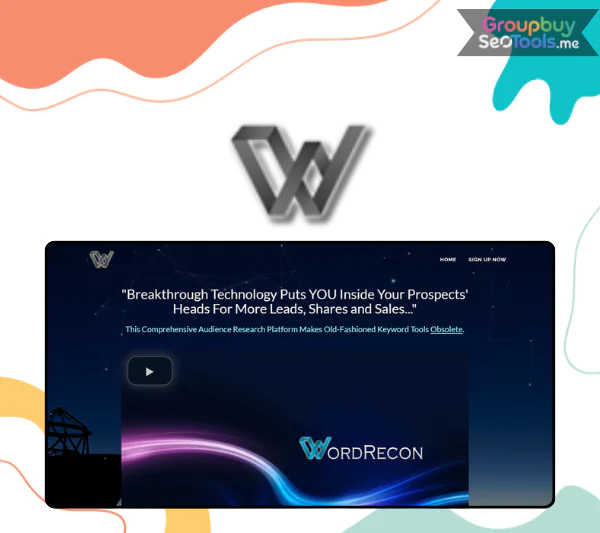 WordRecon at a Glance: Core Definition and Hero Overview
WordRecon is a keyword research intelligence platform that aggregates real, live auto suggest queries from 18 platforms, including Google, YouTube, Amazon, and Reddit, to help marketers and SEO teams discover what real people actually search for across the entire web. It does not generate modeled estimates or recycle stale databases. It taps live public suggestion streams from the platforms users actually type queries into, then cleans, groups, and surfaces the results for action.
Based on more than 10 years of experience reviewing software, tools, and technology in the search and marketing space, this guide is an independent, non sponsored overview. WordRecon’s mission is to make real user search behavior accessible and affordable for solo operators, agencies, and enterprise teams who have been priced out of enterprise SEO suites.
Why this matters in practice:
Most traditional keyword tools index Google data and stop there. The problem: users search differently on Amazon than on Google, ask different questions on Reddit than on YouTube, and use entirely different language on TikTok. WordRecon unifies these suggestion streams so you see the complete picture.
| Dimension | WordRecon | Typical Keyword Tool |
| Data sources | 18 platforms | Usually Google only |
| Data type | Real auto suggest queries | Modeled volume estimates |
| Long tail coverage | Deep across platforms | Limited to Google related searches |
| Platforms covered | Search, video, ecommerce, forums, social | Primarily search |
| Pricing model | Accessible to solo operators | Often enterprise tier |
A short example illustrates the breadth. A seed query like “best trail running shoes” produces meaningful variations on Google (“best trail running shoes for flat feet”), YouTube (“best trail running shoes review 2026”), Amazon (“trail running shoes waterproof mens”), and Reddit (“trail running shoes that don’t blister”). Each platform reveals a different angle on the same underlying user need. The rest of this guide unpacks how WordRecon works, who it fits, and how to start using it productively.
For non-technical readers, WordRecon is essentially a unified window into the autocomplete bars of 18 major platforms, with the data organized so you can actually use it for SEO, content, and PPC decisions.
The step by step process:
A critical clarification: WordRecon does not scrape private data or access protected accounts. It pulls only from public auto suggest endpoints that any user can see by typing into a search bar. The legal and ethical position is straightforward, since the suggestions are intentionally public signals that platforms publish to help users find what they want.
The “real data versus estimates” angle deserves emphasis. Traditional keyword tools assign volume numbers like “8,100 monthly searches” using models, sampling, and historical patterns. Those numbers can be useful, but they are estimates rather than measurements. WordRecon takes a different approach by surfacing the actual queries platforms autocomplete, which is direct evidence that real users type those phrases. A keyword appearing in Google autocomplete is not a model output; it is a signal that enough users have typed that exact phrase for Google to suggest it.
A mini worked example: one seed keyword like “Notion templates” can turn into more than 100 distinct ideas across Google (how to use Notion templates), YouTube (Notion templates tutorial), Amazon (Notion productivity books), and Reddit (best Notion templates for students). Each cluster supports different content formats and channels.
The platform pulls suggestions in real time or near real time from 18 supported sources spanning major search engines, video platforms, ecommerce marketplaces, social networks, and question and answer communities. Scale matters here: millions of queries flow through the pipeline at any given time, with deep long tail coverage on platforms that traditional tools ignore entirely.
The benefits compound across use cases. WordRecon captures emerging language and trending phrases as they actually appear on platforms, often surfacing new terms weeks or months before they appear in classic keyword databases. It also reveals niche terminology that users in specific communities adopt, language that mainstream tools never index because the search volume looks negligible on Google alone.
A practical example: a completely new product category often surfaces first in YouTube or TikTok autocomplete because video native users adopt new terminology faster than the general search population. WordRecon catches those signals while traditional tools wait for monthly database refreshes.
The segmentation layer lets users view queries by platform and compare how a single topic shifts across channels. The same seed keyword often produces dramatically different intent patterns on Google versus YouTube versus Amazon, and seeing those differences side by side changes content strategy.
| Platform | Intent Pattern | Best Content Format |
| Informational and navigational | Blog posts, guides | |
| YouTube | Tutorial and review | Long form video |
| Amazon | Commercial and transactional | Product pages |
| Discussion and recommendation | Community engagement |
Channel specific strategies emerge directly from the data. A topic that shows heavy commercial intent on Amazon but informational intent on Google tells you to build product pages for one channel and educational content for the other rather than treating them as the same audience.
The filtering layer is where serious keyword research happens. Available filters typically include platform, language, country, query length (short head versus long tail), automated intent classification (informational, navigational, commercial, transactional), and modifier groupings such as “how to,” “best,” “vs,” “near me,” price modifiers, and brand modifiers.
Automated intent classification matters because it lets you map keywords to specific marketing objectives without manual sorting. For SEO content planning, informational queries map to blog posts and guides while commercial queries map to comparison and product pages. For PPC, transactional queries belong in your highest bid ad groups while informational queries belong in nurture funnels or are filtered out entirely. For ecommerce, modifier groupings reveal which product attributes (size, material, color) shoppers actually search for.
A practical example: a seed like “best running shoes” splits cleanly into informational content queries (“best running shoes for beginners”), buyer guide queries (“best running shoes 2026 reviews”), and local store queries (“best running shoes store near me”) once you apply the modifier and intent filters.
WordRecon supports standard export formats including CSV, Google Sheets, and JSON for direct integration with your existing workflow. Integrations via Zapier connect WordRecon output to Google Ads, GA4, popular SEO tools, and content management systems.
API access becomes valuable at the enterprise level. Teams use the API to feed internal dashboards, automate recurring keyword refreshes on a scheduled cadence, and integrate WordRecon data into proprietary content planning systems. The API turns WordRecon from a research tool into part of an automated content pipeline.
The trend layer tracks shifts in suggestion patterns over time, revealing seasonal spikes such as “gift ideas” queries climbing toward the holiday season or “tax prep” queries spiking in early year. Beyond seasonality, the platform flags rising topics earlier than tools that refresh on monthly cycles, since auto suggest data updates continuously rather than waiting for the next database release.
Use cases for trend detection include editorial calendar planning where content teams schedule pieces ahead of predictable seasonal peaks, and early stage niche discovery where operators identify rising categories before competitors flood the market.
Trust in any research tool depends on understanding how the data is collected and presented. WordRecon’s transparency posture matters here.
The honest framing helps users interpret results correctly. A keyword’s presence in WordRecon means it is a real query users type; it does not mean the keyword has a specific monthly search volume, and the platform does not pretend otherwise.
The most common pain point in agency SEO is limited long tail discovery from Google centric tools and difficulty building topical maps at the scale clients expect. WordRecon helps by surfacing 10 times more related queries across platforms in a single session, and by enabling topic cluster construction from actual user questions surfaced on Reddit, Quora, and Stack Exchange. A common agency outcome: moving from 50 to 500 plus relevant keywords for a client niche in roughly 20 minutes of focused research.
Editorial teams hit ideation bottlenecks when content stops mapping to real user questions. WordRecon helps by mining Quora and Reddit for explicit pain points users articulate in their own words, and by using YouTube and TikTok queries to design video plus article campaigns that capture multi format demand. A typical output: a 10 piece content cluster derived from a single seed topic, organized across formats and channels.
Paid media teams use WordRecon to expand ad groups with mid and long tail commercial queries pulled from Amazon, Google, and YouTube, then use cross platform context to identify negative keywords that would waste budget. The savings compound. Filtering out irrelevant queries before a campaign launches typically reduces wasted spend, while focusing budget on high intent mid tail queries lifts conversion rates.
Ecommerce operators face a unique challenge: optimizing product titles and descriptions for the specific queries shoppers type on Amazon, eBay, or Walmart, which differ from Google search. WordRecon helps by surfacing attribute level modifiers (size, color, material, connector type) that real shoppers actually type. A simple example: a seed like “garden hose” produces dozens of length, material, and connector modifiers in Amazon autocomplete that should appear in your product listings if you want to compete in those queries.
Video creators use WordRecon to inform titles, tags, and playlist strategy from YouTube and TikTok suggestions. The platform surfaces variations like “X for beginners,” “X mistakes to avoid,” “X hacks,” and “X review” that drive predictable engagement on video platforms. A creator in a niche like “Notion templates” can pull 20 plus topic angles from one seed, sequencing them across a content calendar that captures different search intents.
Affiliate marketers and niche site builders use WordRecon to find underserved micro niches across platforms and validate search intent before committing months of content investment to a topic. Product and market research teams use question heavy platforms like Reddit and Stack Exchange to identify unmet user needs that translate into product features or new categories. A common pattern: spotting a feature gap repeatedly mentioned in question style queries, then building or positioning a product to fill that gap.
Google Keyword Planner is excellent for one specific job: bidding on Google Ads. For multi platform discovery, it falls short because it indexes only Google data and presents queries through a Google Ads bidding lens rather than a broader content strategy lens.
| Dimension | WordRecon | Google Keyword Planner |
| Data sources | 18 platforms | Google only |
| Long tail coverage | Deep across all sources | Limited and bucketed |
| Use case fit | Discovery and content strategy | PPC bidding |
| Freshness | Continuous suggestion updates | Periodic database updates |
| Platform diversity | Search, video, ecommerce, forums | Google search and shopping |
| Cost | Subscription tiers | Free with Ads account |
WordRecon reveals queries on Amazon, YouTube, and Reddit that Google Keyword Planner will never show. The two tools serve genuinely different jobs and many serious operators use both.
The comparison against all in one SEO suites is less competitive than complementary. Ahrefs and SEMrush remain the gold standard for backlink analysis, rank tracking, SERP overviews, and site audits. WordRecon is a specialized discovery engine that fills the multi platform keyword research gap those suites leave.
| Dimension | WordRecon | Ahrefs and SEMrush |
| Primary purpose | Keyword discovery across platforms | Full SEO suite |
| Data type | Live auto suggestions | Modeled estimates and backlink data |
| Features included | Discovery, intent, trend detection | Rank tracking, backlinks, site audits |
| Learning curve | Low | Moderate to high |
| Pricing tier | Accessible | Mid to higher tier |
Most serious SEO stacks include both: a suite for the SERP, backlink, and ranking layer, and WordRecon for the multi platform keyword discovery layer that suites do not cover well.
WordRecon’s most direct competitors are other suggest based tools like Ubersuggest, AnswerThePublic, and Wordtracker. The differences sit in source coverage, refresh frequency, and analytical depth.
WordRecon’s 18 source breadth significantly exceeds most competitors in the suggest tool category. Ubersuggest covers Google primarily with some additional sources. AnswerThePublic focuses on Google and Bing question style queries. Wordtracker indexes a curated database that updates less frequently than live auto suggest pulls.
Refresh frequency matters because keyword landscapes shift weekly in fast moving categories. WordRecon’s continuous suggestion harvesting catches new terms faster than tools that refresh monthly. Intent classification and trend detection are more developed than in basic suggest tools, which often present raw lists without the segmentation that makes the data usable.
Export and integration robustness also separates serious tools from basic ones. WordRecon’s CSV, Google Sheets, JSON, Zapier, and API options support real production workflows. For solo operators doing occasional research, simpler tools may be enough. For teams running keyword research continuously, the integration depth becomes essential.
Sign up at the WordRecon website. The free trial gives access to evaluate the tool before committing. Starter, Professional, and Enterprise plans differ in source coverage, export volumes, and API access. Confirm current pricing on the official site before subscribing.
Pick a seed keyword based on your product, niche, or content focus. Avoid starting with an overly generic term like “marketing” or “fitness,” since those produce sprawling results that are harder to act on. A specific seed like “running shoes for flat feet” or “Notion templates for students” produces tighter, more actionable output.
Select your target languages and regions to match where your customers actually live. Decide whether to query all 18 sources at once for broad discovery or focus on a subset for a specific channel strategy. Trigger the search and read the results layout, which typically organizes by keyword, source platform, classified intent, and detected modifiers. The first search teaches the interface; subsequent searches become significantly faster.
Once results are loaded, the filtering layer is where you separate signal from noise. Isolate YouTube queries to plan video content. Filter by Amazon queries to inform product listing optimization. Filter by commercial intent or “how to” modifiers to focus on specific content formats. A productive first project: building a list of 30 blog topics plus 10 video ideas plus 10 product page targets from a single seed keyword in under an hour.
Export your filtered list to CSV or Google Sheets and sync with your existing SEO and PPC tools. Prioritize columns by intent classification, source platform, and novelty score where supported. The export is where WordRecon stops being a research session and starts being a production input for your content calendar, ad campaigns, or product listing roadmap.
No, in most cases. WordRecon complements Ahrefs, SEMrush, or Moz rather than replacing them. The suites cover backlinks, rank tracking, and SERP analysis that WordRecon does not address. WordRecon covers multi platform keyword discovery that suites cover poorly. Used together, the stack is stronger than either alone.
WordRecon does not provide modeled monthly search volume numbers, rank tracking, backlink data, or SERP feature analysis. The platform focuses exclusively on real user query discovery across 18 sources, with intent and trend analysis layered on top. Use a complementary SEO suite for the metrics WordRecon intentionally omits.
No. WordRecon uses frequency and cross source signals rather than inflated volume estimates. A keyword that appears in multiple platform suggestions across multiple regions is a strong signal; a keyword that appears in only one source is a weak signal. Interpret presence and breadth rather than reading specific volume numbers, since those numbers in traditional tools are themselves estimates rather than measurements.
SaaS companies, ecommerce stores, local service businesses, info product creators, affiliate marketers, and B2B marketing teams all benefit. The platform is particularly strong for any industry where customers research across multiple platforms before purchasing, which describes most modern buyer journeys.
Yes. Language and locale support covers major global markets, with depth varying by region and platform combination. English coverage is the most comprehensive, but major European, Latin American, and Asian languages are supported across the primary sources. Always validate coverage for your specific target markets before committing to high volume usage.
The right cadence depends on your topic’s volatility. Quarterly refreshes work for evergreen niches like financial planning or home improvement. Monthly refreshes fit fast moving topics like SaaS tools or fashion. Weekly refreshes serve trending content categories like news commentary or pop culture coverage.
Yes. The user interface is intentionally simple for first time users, with quick start workflows that produce useful results in the first session. The platform is also powerful enough for advanced teams running enterprise scale research, which means it grows with your skills rather than capping you at a basic tier.
The cleaning layer removes spam patterns, duplicate suggestions, and irrelevant character sequences that auto suggest endpoints occasionally produce. It standardizes formatting across sources, which matters because different platforms format suggestions differently. The goal is presenting genuine user queries cleanly, not curating or editorializing what users actually search for.
People Also Ask scrapers pull questions Google surfaces below search results. WordRecon pulls auto suggest queries across 18 platforms including but not limited to Google. The two data types serve different purposes: PAA reveals follow up questions Google thinks users have, while WordRecon reveals queries users actually type in the first place. Both can be useful, but they answer different questions about user intent.
Yes. Geographic modifiers and locale filters surface “near me” style queries and city specific variations that drive local search visibility. Local SEO teams use WordRecon to find both the obvious “service plus city” queries and the longer tail variants where shoppers describe their needs in their own words. Pair WordRecon with a local SEO suite for rank tracking and listing management.
WordRecon fits modern marketing stacks as the multi platform keyword discovery layer that traditional tools leave underserved. If you publish content, run paid campaigns, or sell products across multiple platforms in 2026, start the free trial this week, run one real seed keyword through all 18 sources, and let the breadth of output decide whether WordRecon earns a permanent place in your stack.
| Time | 1 Month, 1 Year, Trial |
|---|
There are no reviews yet.