 Google
 Microsoft
 Adobe
Adobe Canva
Canva Kaspersky
Animate AI
$101.00

$101.00
Sent via customer’s email
12-24hrs
All-in-one Subscription
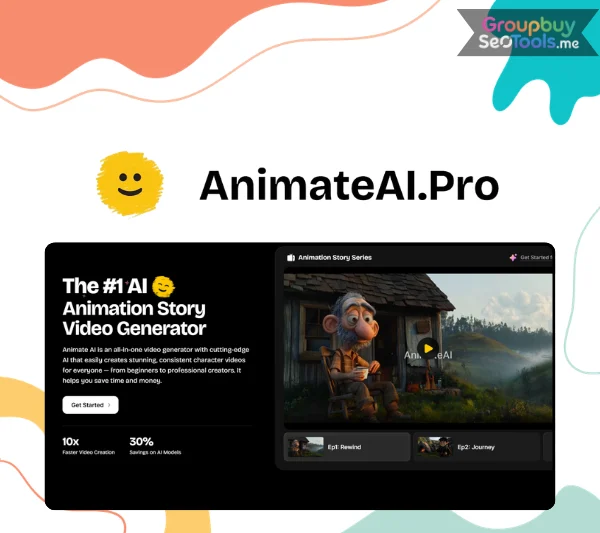
Animate AI: Control complex character physics, sync contextual BGM automatically, and scale your animation studio fast.
The animated video production stack for most creators looks like this:
A script written in Google Docs. Character references assembled in Figma or Canva. Storyboards built manually or outsourced to a freelancer. Video clips generated one at a time in Kling or Runway. Voiceovers recorded separately and imported into Premiere. Music sourced from a subscription library. Final edit assembled by hand.
Seven tools. Seven workflows. Three to four weeks per episode. Thousands of dollars per minute of finished animation.
Animate AI makes one specific claim against this stack: that a single platform — one subscription, one interface, one production pipeline — can replace the entire workflow and deliver a finished animated video 10x faster at 30% lower cost.
This review tests that claim. Not the marketing version of it — the technical version. What the architecture actually does, what the output actually looks like, where the platform genuinely delivers, and where the honest gaps are.
Here is what the investigation found.
Before evaluating a platform, it is worth being precise about what it claims — because the claim defines the standard by which it should be judged.
Animate AI makes three specific claims:
Claim 1: World’s first all-in-one AI video generator for animated series. The emphasis is on “animated series” — not single clips. The platform is explicitly designed for multi-scene, multi-episode content with character continuity, not isolated clip generation.
Claim 2: 10x faster than traditional animation. This refers to the complete production cycle — character design through finished video — compared to traditional frame-by-frame animation or outsourced production workflows.
Claim 3: 30% cost savings on AI model usage. This refers specifically to the platform’s multi-model fusion architecture, which routes generation tasks to the most credit-efficient model meeting quality requirements for each scene — not a comparison against traditional production costs.
The first claim is the one that matters most technically. Single-clip AI video generation is a solved problem — dozens of tools do it well. The unsolved problem, the one that has made every other AI video tool inadequate for series production, is character consistency.
The character consistency problem: diffusion-based video models (Kling, Runway, Sora, MiniMax Hailuo) generate each scene independently. Without external consistency enforcement, the same character described with the same prompt looks visually different in every generation — different facial proportions, different hair, different clothing details. For a YouTube series, a kids’ story, or any multi-episode animated content, this makes the output unusable.
Animate AI’s claim is that its architecture solves this. The technical evaluation of how it does so is the core of this review.
Animate AI is structured as a four-layer production system sitting on top of multiple AI video generation models rather than replacing them.
Layer 1 — Character consistency infrastructure
The foundation layer. Reference image locking anchors character visual identity to a base reference using img2img and control net integration — each generation conditions against this reference rather than generating from text alone. Persistent visual memory stores character identity and references it automatically at every scene generation without manual re-prompting. The combination produces cross-scene visual continuity that text-prompt-only generation cannot achieve.
Layer 2 — Storyboard production system
The storyboard layer converts scripts into structured production documents. NLP parsing identifies narrative beats, generates scene visuals and descriptions, assigns camera angles and timing, and integrates narration with voiceover sync. All panels are editable before any credit-consuming generation begins.
Layer 3 — Multi-model generation engine
Five AI video generation models selectable at the scene level: Kling 1.6 Standard, Kling 1.6 Pro, MiniMax Hailuo 02, Kling 2.0 Master, and Kling V2.5 Turbo Pro. Automated prompt optimization enhances scene descriptions before sending to generation models.
Layer 4 — Production automation (Autopilot)
The autopilot layer renders the full video from an approved storyboard without manual step-by-step generation. Voiceover integration, per-character voice assignment, and music generation run embedded in the autopilot sequence.
The architectural logic: Animate AI does not try to build a better video generation model. It builds the production infrastructure — consistency enforcement, storyboard management, multi-model routing, voiceover integration — that turns individual clip generators into a series production pipeline.
Convert any script into an editable visual storyboard, then render high-quality 30-second clips with a single click.</caption]
The character system is the platform’s technical foundation. Characters are created through style parameter inputs, visual appearance descriptions, and voice assignment. The character library stores completed characters for instant reuse across unlimited future projects.
The storyboard system transforms scripts into structured, editable production documents. Each panel is generated with: scene visual, scene description, narration text, voiceover timing, camera angle, and movement specification.
Zero-credit editing is the most operationally important feature in the storyboard system. Every panel adjustment — camera angle, scene prompt, narration, pacing — happens at zero credit cost. All improvements at this stage carry forward into video generation for free. Corrections after autopilot generation require credit-consuming re-renders.
The production implication: the storyboard review is the highest-leverage quality investment in the entire pipeline. Time spent here is worth significantly more than equivalent time spent anywhere else in the production process.
Five generation models available with scene-level selection:
| Model | Quality | Credit Cost | Ideal For |
| Kling 1.6 Standard | Standard | Low | Establishing shots, backgrounds |
| Kling 1.6 Pro | Good | Moderate-low | Standard narrative scenes |
| MiniMax Hailuo 02 | Varied style | Moderate | Style variation, alternative looks |
| Kling 2.0 Master | High | Moderate-high | Hero scenes, complex interactions |
| Kling V2.5 Turbo Pro | Premium | High | Cinematically critical scenes |
Scene-level model selection enables credit budget optimization: applying efficient models to background and transitional scenes, premium models to close-ups and hero scenes. This granularity is how the 30% cost savings claim is operationalized in practice.
Autopilot renders the complete video from an approved storyboard — full scene sequence, locked character consistency, per-character voiceover, music integration — without step-by-step manual generation. This is the mechanism behind the 10x speed claim: not individual scene rendering, but full-pipeline automated production.
Pre-built production templates from the Animate AI creator community: animated trailers, kids’ stories, motivational clips, explainer videos, social media reels, YouTube series formats. Templates function as production starting points and quality benchmarks. Customizing templates with original characters and scripts produces stronger results than publishing defaults.
AI voiceover generation is embedded in the production pipeline with narration timing synchronized to storyboard during autopilot rendering. Per-character voices run consistently throughout all dialogue automatically. Music integration follows the same embedded workflow model.
Post-render quality refinement tools for scenes that do not meet production standards on initial generation. Targeted enhancement without full re-rendering in all cases.
Simultaneously link prompts across leading generators like Midjourney or Flux and deploy smart autopilot enhancements for superior video quality.
| Features | Standard Plan | Pro Plan |
| Price | $5.99 first week Then $39.99/month |
$99.99/month |
| Credits per Month | 500 Credits | 2,000 Credits |
| Daily Login Bonus | +60 Credits/month | +60 Credits/month |
| Supported Video Models | Kling 1.6 Standard Kling 1.6 Pro MiniMax Hailuo 02 |
Kling 1.6 Standard Kling 1.6 Pro MiniMax Hailuo 02 Kling 2.0 Master Kling V2.5 Turbo Pro |
| Scenes per Video | Up to 10 scenes | Up to 10 scenes |
| Queue Limit | Up to 2 tasks | Up to 2 tasks |
| Fast-Track Generation | ✓ | ✓ |
| Multi-Language Support | ✓ | ✓ |
| Ultra-High-Quality Models | ✓ | ✓ |
| No Watermarks | ✓ | ✓ |
| Personalized Tech Support | — | ✓ |
| Priority Access to New Models & Features | — | ✓ |
Need extra credits? Purchase additional credits anytime. Credits expire 30 days after purchase.
| Credit Pack | Price |
| 200 Credits | $19.99 |
| 500 Credits | $39.99 |
| 1,000 Credits | $59.99 |
| 2,000 Credits | $99.99 |
Explore monthly credit packages designed to scale seamlessly from basic personal projects to heavy-duty enterprise video rendering.
The use case with the most direct alignment to the platform’s design. Multi-episode animated channels require character consistency across episodes — the production requirement that standard AI video tools cannot meet. Animate AI handles episode-to-episode continuity automatically through the character library and persistence system. The storyboard and autopilot workflow handles per-episode production without rebuilding character assets between recordings.
Character-driven narrative for children’s animation depends more heavily on character consistency than perhaps any other video format — viewers build attachment to characters, and visual inconsistency breaks that attachment. The template library specifically supports kids’ story formats. Voiceover and music integration handles the audio production elements that would otherwise require separate tools.
Animated explainer videos, product features, and brand storytelling. Agency-commissioned animated marketing videos typically cost thousands of dollars and take weeks. Animate AI compresses turnaround to hours and cost to a monthly subscription. The template library provides standard explainer formats for faster production.
Short-form animated content for TikTok, Instagram Reels, YouTube Shorts. The free plan’s 3-scene limit covers most short-form formats, making it viable for social content evaluation without a paid subscription.
Animated instructional content for e-learning courses, onboarding, and corporate training. Significantly lower cost than commissioned animated e-learning with comparable output quality.
| Content Type | Scenes Needed | Free Plan | Right Plan |
| YouTube series episode | 8–15 | No | Standard / Pro |
| Kids’ story | 5–10 | Test only | Standard |
| Marketing explainer | 4–8 | Test only | Standard |
| Social reel | 2–4 | Yes | Free / Standard |
| Animated trailer | 6–12 | No | Standard / Pro |
| Training module | 10–20 | No | Pro |
The most clarifying comparison. Kling AI is the technology running three of Animate AI’s five generation engines (Kling 1.6, 2.0, V2.5). Kling’s own platform generates individual high-quality clips. It has no native storyboard system, no character consistency architecture, and no series production workflow.
Animate AI is what Kling AI becomes when you add series production infrastructure on top of it. For isolated clip generation, Kling’s platform works well. For animated series using Kling technology, Animate AI is the necessary layer above it.
Runway excels at cinematic live-action generation, video editing, and VFX. Different design target from Animate AI: live-action and editing versus animated series production. For live-action, Runway is the stronger tool. For animated series with character consistency, Animate AI covers what Runway is not designed for.
Sora generates high-quality video including animated styles. No multi-scene pipeline, no character consistency architecture, no storyboard system. Achieving cross-scene consistency requires significant prompt engineering with inconsistent results. The fundamental comparison: Sora is a generation model. Animate AI is a production system built on top of generation models. For series production, infrastructure matters as much as generation quality.
Template-based platforms with pre-built character libraries and manual scene configuration. Neither uses AI character generation or automated storyboarding. Animate AI produces comparable output quality faster with AI-native workflows that extend beyond fixed template constraints.
| Platform | Character Consistency | Storyboard | Series Production | AI Models | Price/Month | Best Use |
| Animate AI | ✔ Native | ✔ Automated | ✔ Full pipeline | 5 models | $29–$100 | Animated series |
| Kling AI | ✗ | ✗ | ✗ | Kling | $37 (Pro) | Quality single clips |
| Runway ML | ✗ | ✗ | ✗ | Runway Gen-3 | $15–$95 | Live-action, editing |
| Sora | ✗ Native | ✗ | ✗ | Sora | ~$20 | Premium clip generation |
| Vyond | Template-based | Manual | ✗ | None | $49–$89 | Template animation |
| Synthesia | Human avatars | ✗ | ✗ | Synthesia | $29+ | Corporate presenter |
Trustpilot reviews from October–November 2025 document consistent issues with billing and subscription management:
Animate AI’s official responses confirm the email cancellation process and state requests are handled daily.
These are consistent reports from real users. A review that does not include them is incomplete. Email [email protected] to confirm the current process before entering any payment details.
The core claim holds: Animate AI is the only platform that combines native character consistency, automated storyboarding, multi-model AI video generation, and series production workflow in one subscription. For animated series production, no comparable alternative currently exists.
For creators who have been blocked by the character drift problem — who have tried Kling, Runway, or Sora for series content and found them unusable for that specific purpose — Animate AI provides the infrastructure that single-clip tools do not.
For creators who need photorealistic live-action video, single-clip generation with maximum model quality, or guaranteed self-service subscription management, the platform is not the right fit.
There are no reviews yet.