 Google
 Microsoft
 Adobe
Adobe Canva
Canva Kaspersky
Brilliant
$82.00

$82.00
Sent via customer’s email
12-24hrs
All-in-one Subscription
Brilliant: Gamify your self-education, tackle adaptive daily challenges, and expand your analytical thinking fast.
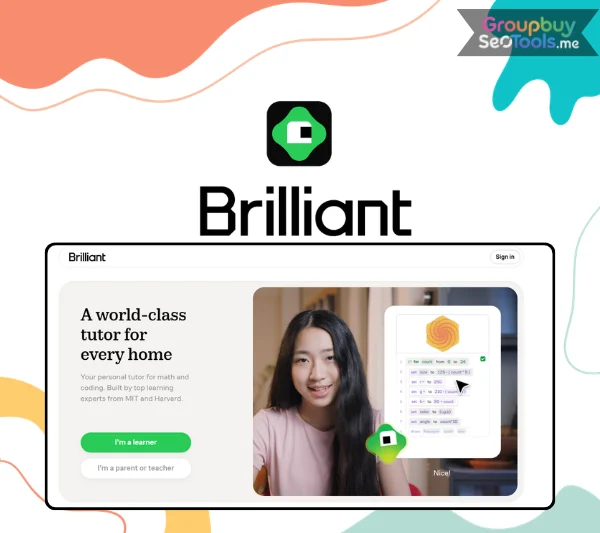
Ten million learners chose Brilliant. That number deserves a moment of attention.
Online learning platforms measure users in the tens or hundreds of millions, so ten million sounds modest — until you consider what those ten million people chose. Not a free resource, not a video library, not a platform bundled with a device they already owned. A subscription product in a market crowded with free alternatives, distinguished primarily by the quality of how it teaches rather than the volume of what it offers.
People do not stay on learning platforms because they think they should. They stay because the platform produces something they care about. For Brilliant‘s ten million, that something is a specific and uncommon experience: the moment when a concept that previously made no sense suddenly, irreversibly makes complete sense. Not familiarity. Not the feeling of having been taught.
Brilliant is built around the mechanics of producing that moment — consistently, efficiently, at a price that does not require an institutional budget, for anyone from a 10-year-old learning fractions to a professional engineer studying quantum computing.
This review tells you exactly what Brilliant is, how it works, what each plan costs, what it genuinely delivers, where it falls short, and whether it belongs in your learning stack.
Walk into almost any online course on almost any platform and the first thing you encounter is a video. Someone explains. You watch. You follow along. You feel, for the duration of the video, like you are learning.
Then the video ends. You try to apply what you just heard. And you discover that watching someone else understand something is almost completely useless for building your own understanding of it.
This is not a design accident. It is the dominant model in online education — and it is why most people who start online courses do not finish them, and most people who finish them cannot use what they nominally learned.
Brilliant built its platform on a different starting point: understanding is not received, it is built. It forms through interaction — through making choices, observing consequences, building intuition through repeated engagement with a concept from multiple angles. No amount of watching someone else experience this can substitute for experiencing it yourself.
Every lesson on Brilliant is constructed as an active exploration. Before any formula is named, before any definition is stated, you interact with the underlying concept. You move a slider and observe what changes. You make a prediction and find out whether you were right. You build something and watch how it behaves. The concept becomes real to you through your own engagement with it — and then, when the formal notation arrives, it is naming something you have already experienced.
This is what cognitive scientists call active retrieval and it produces retention rates four to five times higher than passive exposure. Brilliant is one of the very few platforms that implements this principle across an entire curriculum rather than as an occasional feature.
The curriculum itself was built by educators and subject-matter experts from MIT, Harvard, Stanford, Cornell, and Caltech. The New York Times described Brilliant as “tantalizing.” The Atlantic called it “advanced.” Apple gave it the App of the Day award. Android designated it a Best App. These recognitions are not from the platform’s first year — they reflect sustained quality over time.
The most important thing Brilliant has added to its platform is not a new course. It is Koji — an AI personal tutor embedded directly into every lesson, built specifically for the purpose of helping learners understand rather than helping them get answers.
The distinction matters enormously and is almost universally misunderstood in the AI tutoring space.
When most AI tools are applied to learning problems, they answer. You ask a question, the AI explains. The explanation may be excellent. It is also, for learning purposes, often counterproductive — because the cognitive work of arriving at understanding is the mechanism by which understanding forms. An AI that removes that work does not accelerate learning. It replaces it with something that resembles learning from the outside but produces nothing durable on the inside.
Koji does the opposite. When you are stuck on a concept, Koji does not hand you the answer. It identifies the specific gap between what you currently understand and what you need to understand, and it asks you a targeted question designed to bridge that gap using your own reasoning. You arrive at the answer through your own thinking — which is the only path to genuine comprehension.
When verbal explanation would be insufficient, Koji reaches into Brilliant’s visual, interactive format — the same interactive elements that define the platform’s lessons — and demonstrates the concept in the mode most suited to the specific kind of confusion you are experiencing.
When a surface-level error reflects a deeper conceptual gap, Koji finds it. A learner making repeated mistakes in a calculus problem may actually be stuck on limits, or on algebra, or on how to read the notation. Koji’s diagnostic capability identifies the root cause rather than addressing the symptom.
Koji also carries your complete learning history on Brilliant — every concept mastered, every error pattern, every subject area where gaps persist. This enables the true personalization that the word “adaptive” is so often applied to without delivering: Koji genuinely speeds up where your mastery data indicates readiness, and genuinely slows down to build targeted practice where gaps persist.
Brilliant frames Koji’s availability precisely: “Sunday night before the test, Saturday morning for fun, and the quiet 20 minutes before dinner.” No scheduling. No commute. No per-session fees. No patience limits.
Brilliant Premium unlocks 40+ courses across four subject areas, all integrated with Koji and updated regularly. The range spans Grade 5 foundational material through university and professional-level advanced content.
The mathematics curriculum runs from Arithmetic Thinking through Calculus in more than 30 courses: Arithmetic Thinking, Proportional Reasoning, Probability and Chance, Visual Algebra, Solving Equations, Quadratics, Calculus, and 26 additional courses covering geometry, number theory, combinatorics, logic, and more.
Visual Algebra is the clearest example of what Brilliant does that conventional instruction cannot. Standard algebra instruction presents variables as abstract symbols governed by memorized rules — learners manipulate them without a mental model of what they represent. Brilliant’s visual approach renders algebraic relationships as spatial, interactive experiences. Equations become objects you balance. Variables become quantities you see changing. The algebraic intuition that years of symbolic practice sometimes fails to produce forms naturally through the visual engagement.
The CS curriculum begins with a philosophical commitment: real programming ability starts with computational thinking, not with language syntax. Thinking in Code — the opening course — teaches problem decomposition, pattern recognition, and algorithmic reasoning without requiring any programming language knowledge. Learners who complete it already think like programmers before they write their first line of Python.
The full sequence: Thinking in Code, Programming with Variables, Thinking in Python, Programming with Functions, Algorithmic Thinking, Computer Science Fundamentals, Introduction to Neural Networks, plus 7 additional courses.
The Introduction to Neural Networks course is one of the most substantively educational AI resources available to general learners. Rather than explaining what neural networks do conceptually, it teaches how they work mechanically — through simulations that let learners actually train networks, observe their behavior in real time, and develop genuine intuition about why deep learning works. In 2025, this kind of mechanistic understanding of AI has moved from specialist knowledge to professional literacy.
The data analysis track covers Exploring Data Visually, Probability in Data, Clustering and Classification, Regression, and Predicting with Probability. These courses build from visual data intuition through statistical reasoning to predictive modeling — not as separate disciplines but as a connected progression.
The regression course, for example, does not just teach the mechanics of fitting a line to data. It builds the mathematical foundation for why regression works, then applies that understanding to real problems. The result is the difference between knowing how to run a regression in Excel and understanding what the output means.
Science courses include Scientific Thinking, Circuits, Digital Circuits, Quantum Computing, and Beyond the Nutshell (a collaboration with Kurzgesagt). The Quantum Computing course deserves specific recognition: it is one of the few resources that makes quantum mechanical concepts genuinely accessible to non-physicists through visual simulation rather than either abstract mathematics or oversimplified metaphor.
Brilliant uses a freemium model. The free plan is permanent and genuine; Premium unlocks the full platform.
Includes: first chapter of every course across all subjects, daily challenge problems, Koji AI tutor preview, and progress tracking across devices. Enough to evaluate whether Brilliant’s interactive approach suits your learning style. Not enough for sustained ongoing learning — the free plan is a genuine evaluation environment, not a working one.
Full unlimited access to all 40+ courses, complete Koji AI tutor inside every lesson, no ads or in-app purchases, new content as it is released. Maximum flexibility, cancel anytime. Best for: learners with specific short-term goals, or those who want to evaluate the full platform before committing to an annual plan.
Everything in Monthly Premium at approximately 50% of the monthly price. One payment per year, cancel anytime, auto-renews annually. The most popular plan and best value for anyone committing to more than six months of active learning. The clear recommendation for most learners.
Fixed-price plan covering up to 6 members. Each member gets their own individual Premium account. Ideal for households where multiple people are learning — children and parents can each progress through their own curriculum at their own pace.
Available for groups of 3 to 50 users. One annual payment for the group at a reduced per-person rate. Best for school groups, professional teams, and organizations supporting structured learning.
One year of Brilliant Premium gifted to another person. The appropriate choice for gifting a learning subscription to a student, family member, or colleague.
K-12 teachers and their students qualify for free Brilliant Premium through the Brilliant for Educators program at educator.brilliant.org. Teachers can create classes, assign specific content, and track student progress. This program makes Brilliant’s approach accessible in classroom settings without budget constraints.
| Plan | Effective Monthly Cost | Annual Commitment | Best For |
| Free | $0 | None | Platform evaluation |
| Monthly Premium | ~$24.99 | None | Flexibility, short-term goals |
| Annual Premium | ~$12.49 | Yes (cancel anytime) | Long-term learners — best value |
| Family Plan | Fixed / 6 members | Yes | Household learning |
| Group Plan | ~$11.33/person | Yes | Classes and teams |
| Gift Plan | ~$161.88 total | N/A | Gifting a subscription |
| Educators | Free | None | K-12 teachers and students |
No platform works for everyone. Here is an honest assessment of Brilliant’s genuine strengths and real limitations.
Brilliant serves meaningfully different audiences, and the value it delivers looks different for each.
| Capability | Brilliant | Khan Academy | Coursera | Udemy |
| Interactive problem-solving design | ✅ Core philosophy | ✅ Strong | ❌ Video-primary | ❌ Video-primary |
| AI personal tutor (Koji) | ✅ | ❌ | ❌ | ❌ |
| Math Grade 5–College | ✅ Full spectrum | ✅ Full spectrum | Partial | Partial |
| Computer Science | ✅ Strong | ✅ | ✅ Strong | ✅ Strong |
| Data Science / Analysis | ✅ | Partial | ✅ Strong | ✅ Strong |
| Science / Quantum Computing | ✅ | ✅ | ✅ | Partial |
| Credentials / Certifications | ❌ | ❌ | ✅ | ✅ |
| Free plan quality | Good | ✅ Excellent | Audit access | ❌ |
| Paid pricing | ~$12.49/mo annual | Free | $39–79/mo | Per course |
| Curriculum expert credential | MIT/Harvard/etc | Strong | University faculty | Varies |
| Educator program (free) | ✅ | ✅ | Limited | ❌ |
The one-sentence version of this comparison:
Use Khan Academy if you want comprehensive free STEM content with video-exercise format and no AI tutoring. Use Coursera if you need credentials or prefer university-faculty-led structured courses. Use Udemy if you need a specific professional skill taught by a practitioner. Use Brilliant if you want to genuinely understand STEM — not just complete it — and the interactive, AI-tutored, visual approach resonates with how you learn.
Ten million people chose to pay for something they could not get from the free alternatives.
Not because they did not know about Khan Academy. Not because they had not tried YouTube tutorials. Not because they lacked other options. They chose Brilliant because it produced something different from what every other resource they had tried had produced.
Understanding. The specific, durable, applicable kind — where a concept that previously made no sense now makes complete sense, and the understanding holds under application rather than evaporating when the lesson ends.
Brilliant‘s interactive design produces this. Koji’s guiding questions build it. The MIT and Harvard curriculum sequences it deliberately. The gamification system — streaks, levels, daily goals — sustains the habit long enough for it to compound into real capability.
The limitations are real: no credentials, STEM only, a monthly price that rewards annual commitment, a Koji that cannot follow you outside the curriculum. For learners whose goals require certificates, for learners who need to study the humanities, for learners on zero budget — there are better options.
For everyone else — for the student who is stuck and wants to understand, the adult who wants to rebuild what school never truly built, the professional who needs STEM capability they can actually use, the parent who wants a tutor that is always patient and always there — Brilliant is the most effective platform currently available for building genuine STEM understanding.
| Time | 1 Year |
|---|
There are no reviews yet.