Data analysts in the US earn median salaries between $70,000 and $95,000. Data scientists clear $120,000–$160,000. Data engineers and AI engineers are pushing higher still. The talent shortage is real, documented, and growing as organizations in every industry realize they are sitting on data they do not know how to use.
The path most people take to these roles is also well-worn: find a data science course on YouTube or a major MOOC platform, spend months watching video lectures, follow along with tutorial code, earn a certificate, apply for jobs — and then discover in the first technical interview that following along is not the same as actually knowing how.
Dataquest (dataquest.io) was built on the observation that this gap is not the learner’s fault. It is the format’s fault. Video instruction teaches watching. Data employers need doing.
Dataquest removes the videos entirely and replaces them with something more demanding and more effective: you write real code, analyze real datasets, and build real projects from the first lesson of the first day. Every career path ends with a portfolio of 15–27 completed data projects that serve as the most credible job application document a data candidate can produce.
The results: 98% of learners recommend Dataquest, more than 1 million users since 2014, 170 million+ hours of hands-on practice logged, and active users at Amazon, Deloitte, NIH, Optum, and Northwestern University.
Here is what the platform actually contains and whether it is the right investment for your career goals.
What is Dataquest ?
Bridge the gap between subjective ad placement and algorithmic audience precision by training marketing squads in structured Machine Learning models
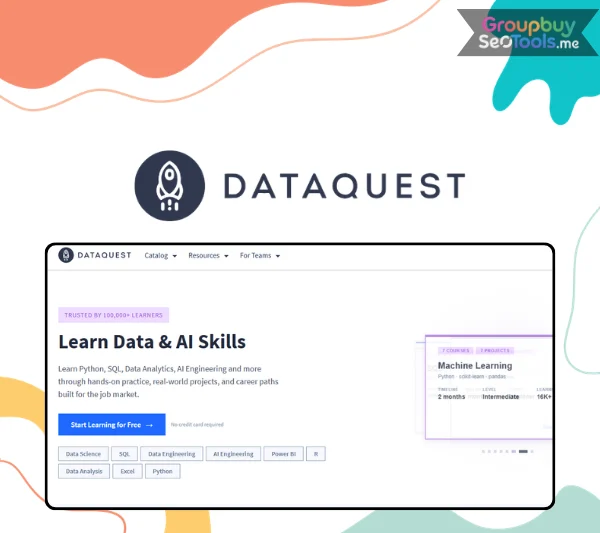
Dataquest is a browser-based data science and programming learning platform. It covers Python, SQL, R, data analysis, data science, data engineering, AI engineering, machine learning, Tableau, Power BI, Excel, and cloud computing — organized into Career Paths, Skill Paths, and individual courses.
The defining feature is what it does not have: instructional videos.
Every Dataquest lesson is text-based and interactive. You read a concept explained in clear, structured prose. You write the code that applies that concept in a live browser workspace. You receive immediate feedback. You move forward only by doing — not by watching.
This is not an aesthetic preference. It is an educational choice grounded in how skill actually develops. Writing code and immediately observing the output is the same feedback loop that expert programmers use when they learn new libraries or tackle unfamiliar problems. Dataquest replicates that loop from the beginning rather than building toward it after a video foundation.
Chandra — Dataquest‘s built-in AI assistant — is available throughout every lesson to provide instant, contextually-aware explanations when you are stuck. It knows exactly which lesson you are working on and provides relevant guidance without requiring you to describe your situation to a generic AI tool.
The credibility behind this approach: in operation since 2014, 100,000+ active learners, 1M+ total users, 170M+ hours of learning, 98% recommendation rate — trusted by teams at Amazon, Deloitte, NIH (National Institutes of Health), Northwestern University, and Optum.
Dataquest Career Paths — Eight Routes to a Job-Ready Outcome
Career Paths are Dataquest‘s most complete offering: structured, job-targeted learning programs that sequence courses, projects, and assessments specifically to produce a candidate ready for a data role. The enrollment numbers alone tell the story of which roles the data market values.
Data Scientist (Python) — 38 courses, 27 projects, ~11 months 447,300+ learners enrolled. Python, statistics, probability, machine learning, deep learning, SQL, and data visualization — built around 27 real-world projects that become a professional portfolio. The most comprehensive path for the field’s highest-paying individual contributor role.
Data Analyst (Python) — 27 courses, 19 projects, ~8 months 437,400+ learners enrolled. Python, SQL, statistical analysis, data cleaning, and visualization — the skills that appear in virtually every data analyst job posting. The most in-demand entry point to a data career.
AI Engineer (Python) — 30 courses, 20 projects, ~10 months (New)158,600+ learners enrolled. Python through AI engineering fundamentals, LLM integration, and model deployment. Built for the role that 2025’s hiring market cannot fill fast enough.
Data Engineer (Python) — 30 courses, 14 projects, ~8 months 125,000+ learners enrolled. Python, SQL, cloud computing, big data, and containerization. The infrastructure layer that makes every other data role possible.
Additional career paths: Data Analyst (R) for R-heavy industries, Junior Data Analyst (Excel + SQL) for the fastest credential-free entry, Business Analyst (Power BI) and Business Analyst (Tableau) for business intelligence roles.
Every path is built backwards from a hiring manager’s checklist — asking what skills and demonstrated work a candidate needs to show, then constructing the path to produce exactly that.
Dataquest Skill Paths — Targeted Mastery in 1–2 Months
Skill Paths are the faster, more focused alternative for learners who want mastery of a specific tool or concept without a full multi-month career commitment.
Python — 4 courses, 3 projects, ~2 months — 339,300+ enrolled The single most important prerequisite for any data role. This path builds Python from fundamentals through data manipulation — and it is the most-enrolled learning path on the entire platform.
SQL — 5 courses, 3 projects, ~2 months — 52,400+ enrolled The skill listed in more data job postings than almost any other. Foundations through advanced queries, joins, and optimization.
Machine Learning (Python) — 7 courses, 7 projects, ~2 months — 17,600+ enrolled Supervised and unsupervised learning implemented on real datasets across seven projects.
Generative AI (Python) and Zero to GPT — understanding and building with large language model technology from the ground up.
Data Analysis (Power BI) — 5 courses, 3 projects, ~1 month — 12,400+ enrolled Business intelligence and dashboard creation using Microsoft’s dominant analytics tool.
Additional Skill Paths: Data Visualization (Python, R, Tableau), APIs and Web Scraping, Data Cleaning, Probability and Statistics, Deep Learning (TensorFlow), R Basics. Full catalog at dataquest.io/catalog/skill-paths.
Dataquest Platform Features
Map multi-tier technical growth paths for teams, scaling systematically from foundational Python blocks to complex cloud database structures
Browser-Based Interactive Code Workspace Write and execute real Python, SQL, or R code directly in the browser — no local environment setup, no installation, no configuration. The workspace behaves like the tools data professionals use in real jobs, which means the transition from studying to working is smoother than platforms that use simplified educational sandboxes.
Real-World Projects — 15 to 27 Per Career Path Every path includes guided projects (structured approach, learner makes key decisions) and unguided projects (problem defined, solution entirely the learner’s). The unguided projects are where the transition from following instructions to independent analytical thinking happens — and where the most credible portfolio evidence is produced.
Data employers evaluate candidates on what they can demonstrate. A portfolio of 19–27 projects built on real datasets using real tools is the most direct answer to a hiring manager’s request to see your work.
Chandra — In-Platform AI Assistant Chandra knows which lesson you are studying and provides instant, contextually-relevant explanations when you are stuck. The practical advantage over external AI tools: you do not have to explain your context before getting relevant help. Chandra eliminates the friction that causes learners to abandon difficult sessions.
Assessments and Practice Exercises Built-in assessments at key checkpoints test whether skills can be independently applied — not just reproduced in the immediate instructional context. Practice exercises between projects maintain skill reinforcement before new material is introduced.
Certificates of Completion Issued for career paths and key courses. Shareable on LinkedIn and addable to resumes — documentation of specific learning investments for professional development records.
Team and Organizational Features For business use: admin dashboard, progress tracking per team member, automated reporting, API for reporting integration, and the ability to assign specific paths to specific learners. These features transform Dataquest from a subscription individuals opt into a managed organizational training program with built-in accountability.
Dataquest Pricing
Evaluate balanced operational billing frameworks, analyzing targeted premium user passes against comprehensive multi-license team plans.
Plan
Monthly Cost
Annual Cost
What’s Included
Free
$0
—
3 lessons per path, introductory courses, community
Premium Monthly
~$49
—
All 70+ courses, all paths, projects, Chandra, certificates
Premium Annual
~$24.50
~$294/year
Same as monthly — ~50% savings
Lifetime
—
~$470–$1,176 (once)
Permanent access, all future content included
Teams Annual
~$24.50/user
Per seat
Premium + admin, reporting, team management
Teams Monthly
~$30/user
—
Premium + team features, flexible
Academic
Custom
Custom
Schools and institutions — contact Dataquest
The free plan is a format preview — three lessons per path is enough to experience the text-and-code learning loop and assess whether it suits your style. It is not enough for sustained progress.
The Annual Premium at ~$24.50/month is the right plan for the vast majority of learners. The ~50% savings over monthly billing, combined with the time commitment that any serious career path requires, make the annual plan the economically correct choice for anyone who expects to be on the platform for more than two months.
The Lifetime plan makes financial sense for learners who expect to return to Dataquest across multiple career goals over multiple years. Data careers require continuous skill development — someone who uses the platform for Python and data analysis, then returns later for machine learning and AI engineering, will find the Lifetime plan eliminates years of recurring subscription costs.
Dataquest Pros and Cons
✅ What Works
Code-first learning produces the skill that employers are actually testing for. The learner who has written 20,000 lines of Python on real datasets has developed something genuinely different from the learner who has watched 20,000 lines being written. Dataquest builds the first kind of learner. The job market rewards the first kind of learner.
Career paths are aligned to what hiring managers require, not what sounds comprehensive. Every course in a Dataquest path exists because it corresponds directly to a skill that appears in data job postings. The sequence is deliberate — each lesson builds on the previous in the order that produces the most effective skill development.
15–27 real projects per career path creates interview-ready portfolio evidence. Career changers and recent learners cannot compete on experience. They can compete on demonstrated work. A portfolio of 19–27 completed analytical projects, built on real data, using real tools, is the most effective response to a hiring manager who asks to see examples of your work.
Chandra removes the most common cause of self-directed study failure. The moment of being stuck with nowhere to turn is where most independent learning breaks down. Chandra’s contextual, in-platform assistance converts that moment into a learning event rather than an abandonment point.
98% learner recommendation across 1M+ users is not a metric you manufacture. A platform that consistently delivers on its promise builds this kind of sustained recommendation rate. Marketing budgets build initial awareness; consistent outcomes build 98% recommendation rates over a decade.
Enterprise trust provides institutional credibility. Amazon, Deloitte, NIH, Northwestern, and Optum have adopted Dataquest for team training. These are not casual choices — they reflect vendor evaluation processes that generic learning platforms do not pass.
The Lifetime plan is a genuine offer, not a gimmick. Permanent access to all current and future content at a one-time price is a meaningful value for learners with long data career horizons. Most platforms do not offer this at all.
❌ What to Know Before Subscribing
No video instruction — format does not suit all learners. Some learners need to hear an explanation or see a concept animated before engaging with it. Dataquest‘s text-only format is a genuine constraint for this learning style. If you have tried text-and-code learning before and found it harder to absorb than video instruction, this is the most important limitation to evaluate.
No mobile app and no offline access. Everything happens in a browser. No iOS or Android app, no downloading lessons for offline use. Studying on commutes or in low-connectivity environments is not supported.
The free plan is too limited to evaluate the full experience. Three lessons per path is enough to assess the format. It does not expose you to projects, Chandra in a challenging scenario, or the arc of a complete learning path.
English-only. No localization for non-English speakers. For learners who read technical English comfortably, this is irrelevant. For learners who need instruction in another language, it disqualifies the platform.
Monthly price is above DataCamp. At ~$49/month, the monthly plan costs more than DataCamp’s premium tier. The annual plan at ~$24.50/month is competitively positioned, but the month-by-month comparison is real.
Dataquest vs. DataCamp and the Main Alternatives
Feature
Dataquest
DataCamp
Coursera
Udemy
Data science focus
✅ Core
✅ Core
✅ Broad
✅ Broad
Interactive browser coding
✅
✅
❌
❌
Real project portfolio
✅ 15–27 per path
✅
Limited
❌
Structured career paths
✅ 8 paths
✅
✅
❌
Built-in AI assistant
✅ Chandra
✅
❌
❌
Video instruction
❌ Text only
✅ Short clips
✅ Full lectures
✅ Full lectures
Certificates
✅
✅
✅
✅
Lifetime plan
✅
❌
❌
Per course
Team/enterprise plan
✅
✅
✅
❌
Annual price
~$24.50/mo
~$12–19/mo
$49–79/mo
Per course
Recommendation rate
98%
~94%
High
Varies
vs. DataCamp: The most direct comparison — both are data-focused, interactive coding platforms with AI assistants and career paths. DataCamp adds short instructional video clips per lesson; Dataquest does not. DataCamp’s annual pricing starts lower. Dataquest offers a Lifetime plan; DataCamp does not. For learners who want some video alongside interactive coding: DataCamp. For pure code-first learning with a larger project portfolio: Dataquest.
vs. Coursera: Different purposes. Coursera is video-lecture-first with university credentials. Dataquest is hands-on practice first with portfolio evidence. These serve different hiring strategies — credentials from institutions (Coursera) vs. demonstrated project work (Dataquest).
vs. Udemy: Per-course marketplace vs. subscription learning environment. Udemy is economical for one specific topic. Dataquest is the structured environment for building a data career over months.
Who Dataquest Is Right For — And Who It Is Not
Strong fit:
Career changers entering data science, analysis, or engineering who lack professional data experience and need portfolio evidence to compete with candidates who have years of on-the-job practice. The project portfolio is the career changer’s most powerful asset, and Dataquest is built to produce it.
Self-starters who prefer reading and doing over watching and repeating. The text-and-code format is demanding — it requires active processing at every step. Learners who find this energizing rather than exhausting tend to progress rapidly and retain what they learn far better than from video-first alternatives.
Working professionals fitting learning into real schedules. Each Dataquest lesson is self-contained and completable in 20–30 minutes. Learning at this granularity makes daily or weekly progress sustainable alongside full-time work — which is how most career changers actually study.
Teams that need data upskilling with accountability reporting. The Teams plan includes progress tracking, admin reporting, and learner assignment tools that make Dataquest manageable as a structured organizational training program.
Not a strong fit: Learners who need video instruction. Learners who need mobile or offline access. Non-English speakers. Organizations needing training outside the data/AI/programming domain.
Frequently Asked Questions About Dataquest
Can I really learn data science without any video instruction?
Yes — and research in learning science supports the idea that text-and-code instruction can be more effective than video instruction for skill development, precisely because it requires active engagement rather than passive observation. That said, learning style matters. If you have previously found text-heavy learning difficult to absorb, the free plan’s three lessons will reveal this quickly and at no cost. If you find yourself genuinely engaged — writing code, observing outputs, solving problems — the format is working.
How does the Dataquest project portfolio compare to what DataCamp offers?
Both platforms include projects, but the volume and depth differ. Dataquest career paths include 14–27 real-world projects; DataCamp’s paths typically include fewer, with a higher proportion of guided structure. Dataquest’s unguided projects — where the problem is defined but the approach is entirely the learner’s — produce the most credible portfolio evidence because they require genuine independent judgment. This distinction matters in interviews where candidates must explain why they made specific analytical decisions.
What does “98% of learners recommend Dataquest” actually mean?
Dataquest collects learner satisfaction data from its user base and reports the percentage who say they would recommend the platform to others. At 98%, across 1 million+ users since 2014, this is a sustained signal of genuine learner satisfaction — not a metric from a one-time survey of a small group. It is the strongest available external validation of whether the platform delivers what it promises.
Is Dataquest’s Chandra AI assistant better than just using ChatGPT while studying? The practical advantage of Chandra over an external AI tool is contextual awareness. When you use ChatGPT for help, you must describe your problem, provide relevant code, and explain what you are trying to do. Chandra is embedded in the lesson and already knows what you are working on — which means explanations arrive faster and are more directly applicable to your specific situation. For in-lesson help during active study, Chandra’s contextual integration makes it more efficient than switching to an external AI.
How much time per week does completing a Dataquest career path realistically require?
At 1 hour per day (7 hours per week), the Data Analyst path (27 courses, ~8 months at Dataquest’s estimate) typically takes 7–10 months. At 2 hours per day, it compresses to 4–6 months. The self-paced format means these timelines are entirely flexible — learners who can invest more time complete paths faster. Dataquest lessons are designed for 20–30-minute study sessions, making daily micro-study sessions practical alongside existing commitments.
Does Dataquest offer any credentials that employers recognize beyond certificates of completion?
Dataquest issues certificates of completion for career paths and individual courses — these are not industry certifications from vendors like AWS, Databricks, or Google. The primary credential that Dataquest graduates bring to employers is their project portfolio: completed analytical and engineering projects on real datasets using real tools. Data employers evaluate candidates primarily on demonstrated capability, not certificates. The portfolio is the credential that matters most in data hiring.
Which Dataquest career path should a complete beginner start with?
For a complete beginner whose goal is employment in a data role, the Data Analyst (Python) path is the recommended starting point. It is the most enrolled path on the platform (437,400+ learners), the most direct path to one of data’s most consistently available roles, and the foundation from which Data Scientist and other advanced paths become accessible. Learners who are not yet ready for Python can begin with the Junior Data Analyst (Excel + SQL) path, which requires no programming background.
 Google
 Microsoft
 Adobe
Adobe Canva
Canva Kaspersky