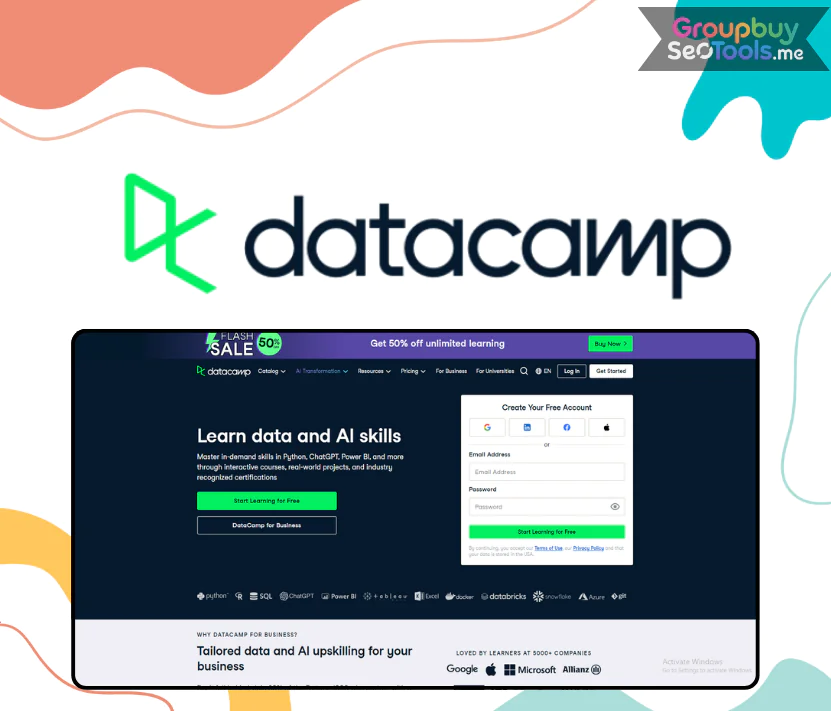
DataCamp – provides interactive, self-paced courses, skill assessments, and hands-on projects covering everything from non-coding BI tools to advanced data science and machine learning.
You will receive: DataCamp Premium(shared account)
Certifications can validate your expertise and open doors to new career opportunities, and one platform making waves in this area is DataCamp. In this comprehensive review, we’ll explore the central question: Is DataCamp truly worth it? Whether you’re a complete beginner with no coding background or a professional looking to enhance your Python, SQL, or R skills, DataCamp combines practical exercises, real-world projects, and structured learning paths to support skill development.
From free introductory courses to specialized career tracks and recognized certificates, GroupbuySeoTools will guide you through everything you need to know about DataCamp. Continue reading to determine if DataCamp fits your data science learning goals.
What is DataCamp?
DataCamp dashboard showing courses, learning tracks, and interactive exercises
DataCamp is an online learning platform designed to help individuals build data-related skills at their own pace. Its course offerings span foundational topics, including non-coding essentials like BI tools, to advanced subjects such as data science and machine learning. The platform emphasizes interactive, hands-on learning, providing skill assessments with personalized recommendations, expert-led courses, coding challenges, and practical projects.
Key Features
Practice with hands-on exercises and real projects to master data skills
Courses, Tracks, and Certifications: DataCamp provides 354 courses, 51 skill tracks, and 12 career tracks, all focused on data science. Learners can gain expertise in Python, R, SQL, and other tools while creating a portfolio of real-world projects.
Career Paths: The platform offers over 15 career paths, including Data Analyst, Data Engineer, Data Scientist, Python Developer, and Machine Learning Specialist. Each path is carefully structured to guide learners step by step. Following a career path often proves more effective than tackling random, unrelated courses.
Skill Tracks: Beyond career paths, there are more than 50 specialized skill tracks covering R programming, data manipulation, visualization, and machine learning. These tracks provide a clear roadmap for developing specific skills.
Interactive Courses: Lessons feature short videos, coding exercises, and quizzes within the browser, allowing learners to immediately apply knowledge without installing additional software.
Real Projects: DataCamp emphasizes practical projects, letting learners apply concepts to real-world datasets. This hands-on approach builds confidence and produces tangible portfolio pieces.
Pricing Plans
Flexible plans for learners, teams, and organizations to scale data skills
Basic (Free): Ideal for newcomers curious about the platform. Offers a risk-free way to explore the learning style before committing financially.
Premium ($13/month, billed annually): The most popular plan, suitable for students, professionals transitioning careers, or anyone seeking structured, ongoing learning at an affordable cost.
Teams ($28/user/month, billed annually): Tailored for businesses or organizations training multiple employees. Includes features like team-level progress tracking.
If official pricing seems steep, GroupbuySeoTools provides access to DataCamp Premium for just $35 per year, a significant discount from standard rates.
Why Buy a DataCamp Account from GroupbuySeoTools?
Guaranteed Quality: Every account is tested thoroughly, fully functional, and ready for immediate use.
Competitive Pricing: Only $50 per year with no hidden charges, offering exceptional value.
Easy Payment: Complete transactions via MOMO or Online Banking with prompt delivery of credentials.
7-Day Refund Policy: Request a full refund within 7 days if unsatisfied.
24/7 Support: A dedicated team is always available to address any issues.
How to Buy and Use DataCamp
Step-by-Step Purchase Guide:
Select Your Product: Choose the preferred plan and add it to your cart.
Confirm Your Order: Review all details before checkout.
Choose Payment Method: Pay via MOMO or Online Banking, providing the correct email for account delivery.
Complete Purchase: Login credentials will be emailed. Follow activation instructions to start using DataCamp.
For full purchasing instructions, visit: https://groupbuyseotools.me/how-to-buy/
Usage Instructions:
Sign Up & Set Goals: Decide which skills or career paths to pursue.
Take the Assessment: Receive personalized course suggestions.
Pick a Track: Follow a Career Track or Skill Track.
Study Consistently: Dedicate 30–60 minutes daily to lessons and exercises.
Practice & Review: Utilize practice mode, take notes, and revisit key topics.
Complete Projects: Apply knowledge on guided projects with real datasets.
Build a Portfolio: Share projects and certificates on LinkedIn to showcase your achievements.
This structured approach ensures you gain hands-on experience, build a professional portfolio, and steadily advance your data science skills.
Advantages
Beginner-friendly design: DataCamp is ideal for those with no prior coding experience. Its step-by-step lessons and guided exercises help learners build confidence gradually.
Extensive course library: The platform offers hundreds of courses covering Python, R, SQL, data visualization, statistics, machine learning, and more, making it a comprehensive hub for data learning.
Interactive learning: Instead of just watching videos, learners code directly in their browser and receive immediate feedback, reinforcing knowledge more effectively.
Skill & Career Tracks: Courses are organized into structured paths, such as “Python for Data Science” or “Data Analyst,” giving learners a clear roadmap rather than feeling lost among numerous options.
Hands-on projects: Users can practice on real datasets, apply their skills, and create portfolio-ready projects to showcase in job applications.
Completion certificates: Every finished course or track grants a certificate. While not equivalent to a university degree, these credentials can enhance your LinkedIn profile or resume.
Flexibility: Learn at your own pace, on desktop or mobile, making it convenient for busy students or professionals.
Disadvantages
Limited free access: Although some introductory content is available for free, most valuable courses require a paid subscription.
Browser-only environment: Coding takes place in a simplified browser setup, which is beginner-friendly but doesn’t fully replicate real-world tools like Jupyter Notebook or terminal workflows.
Not always in-depth: Some courses cover only the basics, which may leave advanced learners seeking more comprehensive material.
Certificates not accredited: DataCamp certificates are not university-backed degrees and may not carry the same weight with all employers.
Less focus on theory: The platform emphasizes practical application over theoretical foundations, which might not suit learners pursuing research or advanced academic work.
Who Should Use DataCamp
DataCamp is best for learners seeking a practical, flexible, and structured way to build data skills. Key audiences include:
Data science beginners: Provides a smooth entry point with guided Python, R, and SQL lessons, no prior coding needed.
Students and graduates: Offers a way to strengthen resumes with projects and certificates, complementing academic studies.
Working professionals: Useful for those in business, finance, or marketing who rely on data-driven decisions.
Career changers: Career tracks give a step-by-step plan for transitioning into tech or data science roles.
Curious lifelong learners: Ideal for anyone interested in exploring data analytics, AI, or problem-solving without committing to a formal degree.
FAQs About DataCamp
Does DataCamp provide certificates? Yes, every completed course or track comes with a certificate that can be added to your resume or LinkedIn.
Is DataCamp suitable for beginners? Absolutely. Interactive lessons make it very beginner-friendly with no prior coding experience required.
Can DataCamp help me get a job? While it doesn’t guarantee employment, the skills, projects, and certificates significantly enhance your portfolio and career prospects.
DataCamp vs Coursera: DataCamp focuses on data science and coding with hands-on exercises, while Coursera offers a broader range of academic subjects with university-backed certifications. Your choice depends on your learning objectives.
How long does a course take? Most individual courses take 4–6 hours. Skill tracks can take several weeks, and career tracks may span a few months, depending on your pace.
Can I study offline? Yes, the mobile app allows you to download lessons and continue learning without an internet connection.
Do employers recognize DataCamp certificates? Many employers value DataCamp certificates as proof of applied data skills, although they do not carry the same weight as formal degrees.
Conclusion
DataCamp is an excellent option for learners seeking a flexible, hands-on approach to mastering data science. While it does not replace accredited programs, it offers practical projects and certificates that strengthen your portfolio and prepare you for job interviews.
Ideal for self-motivated learners and career changers, DataCamp simplifies learning Python, R, SQL, and machine learning at a reasonable cost. For the best value, consider purchasing through GroupbuySeoTools, which provides full platform access at a lower price.
 Google
 Microsoft
 Adobe
Adobe Canva
Canva Kaspersky