 Google
 Microsoft
 Adobe
Adobe Canva
Canva Kaspersky
Thumbnail AI
$101.00

$101.00
Sent via customer’s email
12-24hrs
All-in-one Subscription
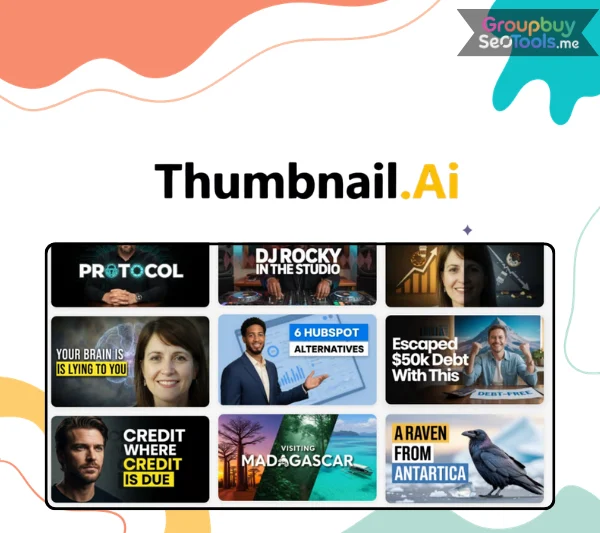
Thumbnail AI: Generate striking neon outline effects, audit visual dominance, and scale multi-channel video CTR fast.
You spend three days filming and editing a YouTube video. The lighting is perfect. The audio is clean. The editing is tight. You upload it — and it gets 200 views.
Meanwhile, a video with half the production quality from a smaller channel gets 50,000 views in the same week.
The difference? The thumbnail.
YouTube’s own internal data consistently shows that a thumbnail is the single biggest variable in whether a viewer clicks your video or scrolls past it. It is your billboard, your book cover, and your first impression — all in a 1280×720 pixel image.
But here is the problem most creators face: making a great thumbnail is hard. It takes real design skill, the right software, and time you do not always have. That is the gap Thumbnail AI was built to close — and it does it better than anything else on the market.
This review breaks down exactly what Thumbnail AI does, what makes it work, who it is built for, and whether it is worth adding to your content workflow in 2025.
Every tool exists because someone felt a pain. Thumbnail AI exists because millions of creators felt the same one: they were pouring creative energy into videos that were invisible — not because the content was bad, but because nothing was drawing viewers in.
Thumbnail AI is a purpose-built AI thumbnail generation platform available at thumbnail.ai. It was created to give every creator — from the solo vlogger posting from their bedroom to the brand team managing ten channels at once — access to professional-quality thumbnails without hiring a designer or learning Photoshop.
The platform currently serves more than 1,100 creators and brands worldwide and positions itself as the #1 AI thumbnail generator for YouTube and social media. That claim is backed by a simple but powerful value proposition: generate stunning, click-optimized thumbnails in approximately 30 seconds, using nothing but a text prompt.
What makes Thumbnail AI genuinely different from other design tools is not the speed — it is the intelligence behind the output. While general-purpose tools like Canva give you templates and let you fill in the blanks, Thumbnail AI generates completely original designs from scratch based on your specific input. The AI does not guess randomly; it applies learned principles of what makes thumbnails perform on platforms like YouTube, where attention is the scarcest resource.
The result is a tool that feels less like a design application and more like a creative collaborator — one that happens to work in 30-second sprints.
The technology behind Thumbnail AI is sophisticated, but using it is intentionally simple. Here is exactly what happens from the moment you open the tool to the moment you have a finished thumbnail ready to upload.
Everything in Thumbnail AI begins with language. You type your video title or a short creative prompt — and the AI takes it from there. This text-to-thumbnail process is the engine of the platform. The model reads your input, interprets the subject matter, emotional tone, and intended audience, and begins constructing visual concepts that align with what makes thumbnails in your content category click-worthy.
The more descriptive your prompt, the more targeted the output. A prompt like “beginner guitar lesson — how to play your first chord” produces very different results from “I tried every guitar in GuitarCenter” — and both should, because the audiences and emotional hooks are completely different.
Once your prompt is entered, you select from a library of more than 15 thumbnail styles. These are not random aesthetic options — each style has been curated based on performance data across different YouTube niches and content categories. Some styles lean into high-contrast, bold typography that works well for educational and finance content. Others emphasize facial expressions and cinematic lighting — the formula that dominates gaming and lifestyle channels.
Choosing the right style for your niche is one of the highest-leverage decisions in the entire process, and having 15+ proven options to explore means you are never choosing blindly.
For creators who want to anchor their thumbnail in a real photo — their own face, a product shot, a scene from the video — Thumbnail AI’s image-to-thumbnail AI feature handles it. Upload your image, pair it with your text prompt and chosen style, and the AI integrates your visual asset into a cohesive, professionally designed thumbnail.
This pathway is especially valuable for personal brand creators and YouTubers who have built audience recognition around their face. Viewers who know and follow a creator expect to see them in the thumbnail — and Thumbnail AI makes including that personal visual element completely frictionless.
Hit generate and within approximately 30 seconds — the time it takes to pour a cup of coffee — you have between 1 and 8 completely unique thumbnail designs ready to review. No two outputs are identical. Each variation represents a distinct creative interpretation of your prompt and style selection, giving you genuine options rather than minor color tweaks on the same base design.
Download whichever variation resonates most, and it is ready to upload directly to YouTube Studio or any other platform.
Thumbnail AI is far more than a single-function generator. The platform includes a full ecosystem of tools designed around the complete thumbnail workflow — from research and inspiration through to creation and iteration.
The core generation engine is powered by advanced AI models optimized for visual content creation. Its defining characteristics are speed — approximately 30 seconds per generation — and uniqueness. Every thumbnail it creates is an original composition, not a template with swapped-out text. This matters because templated thumbnails are visually indistinct in a feed where originality and visual surprise are what stop the scroll.
The Remixer is one of Thumbnail AI’s most practical tools for creators who publish content in series or who repurpose existing material. Take any thumbnail you have already created — inside Thumbnail AI or elsewhere — and use the Remixer to generate fresh variations based on the same underlying concept. This preserves visual continuity across a series while keeping each individual video looking distinct and current.
For channels that revisit evergreen topics — annual “best of” lists, seasonal guides, or regular challenge videos — the Remixer is invaluable. It eliminates the need to start from scratch every time while ensuring your thumbnails never look stale or recycled.
The Thumbnail Grabber is a competitive intelligence tool built directly into the platform. Enter any YouTube video URL and Thumbnail AI extracts its thumbnail instantly. Use it to study what top-performing channels in your niche are doing visually — what colors dominate, whether faces or text are front and center, how much whitespace is used, and what emotional tone the thumbnails project.
This is not about copying competitors. It is about understanding the visual language of your niche before you generate your own thumbnails — and using that understanding to position your content to stand out from, not blend into, the surrounding feed.
While the AI generator automates the entire design process, the Maker tool offers an additional layer of hands-on control for creators who want to fine-tune specific elements. It bridges the gap between full automation and traditional design, giving users the best of both approaches without requiring professional design expertise.
Thumbnail AI supports three aspect ratios covering the full spectrum of modern content platforms:
16:9 — Standard YouTube The universal format for long-form YouTube videos. Every YouTube thumbnail defaults to this ratio, and Thumbnail AI’s AI models are most deeply trained on what drives performance in this format.
9:16 — Shorts, TikTok, and Reels Vertical content has become a dominant format across every major platform. Thumbnail AI’s 9:16 output is optimized for the visual conventions of short-form content — fast, bold, and immediately legible on a mobile screen.
1:1 — Social Media Square For Instagram, Facebook, and LinkedIn content, the 1:1 square format is the standard. Having all three ratios available within a single tool means you can create consistent visual branding across every platform your content lives on, without context-switching between different applications.
Understanding the pricing structure is straightforward because Thumbnail AI operates on a freemium model designed to serve creators at every stage of growth.
The free plan is a genuine entry point, not a heavily restricted demo. New users can generate AI thumbnails at no cost and experience the full quality of the platform’s output before committing to any paid tier. This removes the risk from adoption entirely — you can see exactly what Thumbnail AI produces for your specific content before spending a dollar.
For occasional creators or those still in early-stage channel growth, the free plan may be sufficient as a permanent solution.
As your content volume increases and thumbnail creation becomes a regular part of your workflow, the premium tiers unlock the full power of the platform. Premium plans offer meaningfully higher generation quotas, access to the complete style library, full use of the Remixer and Thumbnail Grabber, and the image upload capability that enables the image-to-thumbnail AI workflow.
| Feature | Free Plan | Premium Plan |
| AI Thumbnail Generations | Limited monthly quota | Higher / Unlimited quota |
| Style Library Access | Core styles | Full 15+ styles |
| Aspect Ratios | 16:9 standard | 16:9, 9:16, and 1:1 |
| Thumbnail Grabber | Restricted | Full access |
| Remixer Tool | Restricted | Full access |
| Image Upload (Image-to-Thumbnail) | Not available | ✅ Available |
| Generation Speed | Standard | Priority processing |
Thumbnail AI offers a 25% commission affiliate program via endorsely.com. For creators, newsletter writers, and marketing educators who regularly recommend tools to an audience, this is a meaningful revenue opportunity with no cap on earnings.
To understand why Thumbnail AI produces results, it helps to understand what YouTube’s algorithm actually rewards — and why most manually designed thumbnails underperform.
YouTube surfaces videos based on a metric called CTR — click-through rate — which measures what percentage of people who see your thumbnail actually click on it. A video with a high CTR gets shown to more people. A video with a low CTR gets buried, regardless of how good the content inside actually is.
CTR is almost entirely determined by the thumbnail.
Most creators who design their own thumbnails make decisions based on personal aesthetic preference — what looks good to them. But viewers are not the creator. They make click decisions in under two seconds, based on immediate visual impact, emotional resonance, and perceived relevance.
Thumbnail AI is trained on the other side of that equation. Its AI models have processed what drives viewer behavior on YouTube specifically — which color combinations increase visibility in different content feeds, which compositions create the visual tension that prompts a click, which styles outperform the average in each major content niche.
When you generate a thumbnail with Thumbnail AI, you are not just getting a design that looks professional. You are getting a design that has been engineered, at the model level, to perform.
Thumbnail AI is a broadly useful tool, but some users extract exceptional value from it based on how they work and what they need.
YouTubers publishing three or more videos per week face a thumbnail bottleneck that most viewers never think about. Each upload needs a fresh, high-quality thumbnail — which means the creator either spends significant time designing, pays someone else to do it, or compromises on quality. Thumbnail AI eliminates this bottleneck entirely. Generating a thumbnail becomes a 30-second task that happens after the upload, not a 45-minute creative project that delays it.
For brands using YouTube and social media as marketing channels, visual consistency across all content is critical for audience recognition. Thumbnail AI’s style system makes it easy to establish a consistent visual language — select the style that aligns with your brand, use image upload to incorporate your brand elements, and every thumbnail you generate carries that identity forward automatically.
Digital marketing agencies producing video content for multiple clients face the same core challenge as high-frequency creators, multiplied by the number of clients they serve. Thumbnail AI’s generation speed and quality floor makes it possible to produce client-ready thumbnails at a pace that traditional design workflows simply cannot match.
Perhaps the clearest use case of all. New YouTubers typically have no design training and no budget for a designer, yet they are competing visually against channels that have had years to develop their thumbnail aesthetic. Thumbnail AI hands every new creator a professional visual capability from day one — removing one of the most significant early disadvantages in the platform.
Podcasters converting audio episodes to YouTube videos face a unique challenge: they often have no video footage and no visual content to anchor a thumbnail. Thumbnail AI’s text-to-thumbnail AI approach is perfectly suited to this use case. Describe the episode topic in a prompt, select a clean editorial style, and generate a professional thumbnail without needing a single piece of video footage.
The AI design tool space has matured rapidly, and there are now several credible options for creators who want AI assistance with visual content. Here is how Thumbnail AI compares to the most commonly used alternatives.
| Capability | Thumbnail AI | Canva AI | Adobe Firefly | MidJourney |
| Purpose-built for YouTube thumbnails | ✅ Yes | ❌ No | ❌ No | ❌ No |
| Text-to-thumbnail generation | ✅ Yes | ⚠️ Partial | ⚠️ Partial | ✅ Yes |
| Image-to-thumbnail integration | ✅ Yes | ⚠️ Partial | ✅ Yes | ❌ No |
| Free tier available | ✅ Yes | ✅ Yes | ✅ Yes | ❌ No |
| Thumbnail Grabber (competitive research) | ✅ Yes | ❌ No | ❌ No | ❌ No |
| Remixer for series/iterations | ✅ Yes | ❌ No | ❌ No | ❌ No |
| CTR-optimized output logic | ✅ Yes | ❌ No | ❌ No | ❌ No |
| No design skills required | ✅ Yes | ⚠️ Learning curve | ⚠️ Learning curve | ❌ Complex |
| YouTube aspect ratio presets | ✅ Yes | ⚠️ Manual setup | ⚠️ Manual setup | ❌ No |
The most important column in that table is the first one: purpose-built for YouTube thumbnails. Every other tool on the list is a general-purpose creative platform that can produce image outputs. None of them were designed specifically to generate thumbnails that perform in YouTube’s discovery environment.
Canva is an excellent design tool. Adobe Firefly is a powerful AI image generator. MidJourney produces stunning generative art. But none of them know what a high-CTR YouTube thumbnail looks like at the model level — because that is not what they were built to do.
Thumbnail AI knows exactly what it was built to do, and it does it better than anything designed for a broader purpose.
Where Thumbnail AI Excels
The platform’s core generation engine is genuinely impressive. Thumbnails arrive quickly, look professional, and feel designed rather than automatically assembled. The 15+ style library is broad enough to cover most niches without feeling generic, and the image-to-thumbnail pathway significantly expands creative possibilities for personal brand creators.
The bonus tools — Remixer, Thumbnail Grabber, Maker — add meaningful depth. The Thumbnail Grabber in particular is an underrated feature; competitive visual research is something most creators skip, and having it built directly into the thumbnail creation workflow removes the friction that typically prevents it.
The free plan is genuinely generous as a starting point, and the freemium model means there is no financial risk in testing the tool with your own content.
Where There Is Room to Grow
The most significant missing piece as of 2025 is in-tool editing. After generating a thumbnail, users currently cannot make fine adjustments — changing the text, repositioning an element, or tweaking a color — without regenerating from scratch. The Thumbnail AI team has indicated this editing and refinement capability is in development, and when it arrives it will address the one meaningful workflow gap the platform currently has.
The free plan’s generation limits will push high-frequency creators toward a paid tier relatively quickly, though the paid plans are priced reasonably for what they deliver.
For creators working primarily outside YouTube — building content exclusively for TikTok or Instagram, for example — the tool’s YouTube-first optimization is less relevant, though the platform does function capably for other formats.
Getting good output from Thumbnail AI from your first session is easy. Getting consistently excellent output requires learning a few practices that take the tool from good to indispensable.
If you have never used Thumbnail AI before, here is exactly how to go from zero to a finished, upload-ready thumbnail.
1. Open thumbnail.ai in your browser.
2. Click Register to create a free account, or sign in immediately using your Google account.
3. From the main dashboard, select AI Create or click “Generate a Thumbnail Now.”
4. In the text field, type your video title or a descriptive prompt. Be specific — include your topic, the emotional hook, and any key visual elements you want represented.
5. If you have a personal photo or brand image to include, click Upload Image and add your file.
6. Browse the Style Library and select the visual direction that fits your content and your channel’s aesthetic.
7. Choose your Aspect Ratio — 16:9 for standard YouTube, 9:16 for Shorts, 1:1 for social media.
8. Click Generate. Within 30 seconds, up to 8 unique thumbnail options appear on screen.
9. Review all variations before deciding. Thumbnail that looked weakest at first glance sometimes performs best in actual feed testing.
10. Download your chosen thumbnail and add it to your video in YouTube Studio under the thumbnail settings.
From account creation to downloaded thumbnail: under three minutes, total.
The honest answer is yes — with almost no qualifications for the majority of creators.
Thumbnail AI solves a real, concrete problem in a way that is fast, accessible, and effective. It takes a task that was previously either time-intensive, skill-dependent, or expensive, and turns it into a 30-second operation that requires nothing but a text prompt and a style preference.
The platform’s core output quality is high enough to compete with manually designed thumbnails in most content niches. Its bonus tools — particularly the Thumbnail Grabber and Remixer — add genuine strategic value beyond simple generation. The free plan removes every financial barrier to trying it. And the AI’s CTR-optimization logic means the thumbnails it generates are not just visually appealing — they are engineered to perform in the environment where they actually need to work.
The missing editing feature is a real gap that will become a non-issue when the team ships it. Until then, the workaround — regenerating with a more specific prompt when you want adjustments — is functional, if slightly inelegant.
For creators who are serious about growing their channel and understand that a great thumbnail is not a nice-to-have but a fundamental performance driver, Thumbnail AI belongs in your workflow. Start on the free plan, generate thumbnails for your next three videos, and compare your CTR data against your historical average. The results will tell you everything you need to know.
| Time | 1 Year |
|---|
There are no reviews yet.