 Google
 Microsoft
 Adobe
Adobe Canva
Canva Kaspersky
CraftyStats
$53.00

$53.00
Sent via customer’s email
12-24hrs
All-in-one Subscription
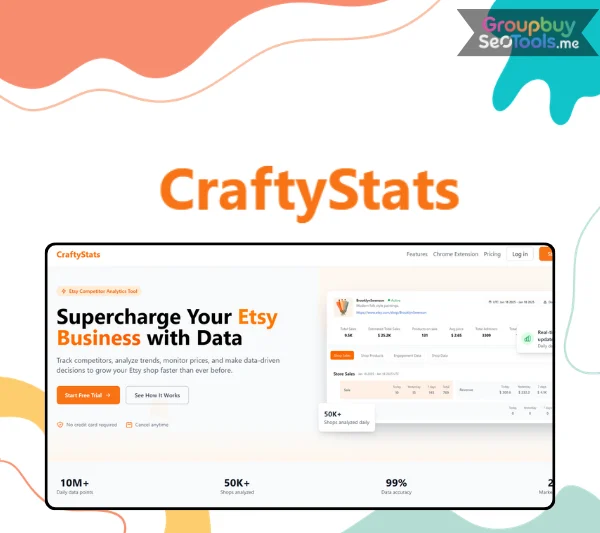
CraftyStats: Monitor competitor Star Seller badges, download custom sales reports, and scale your Etsy shop fast.
What if you knew exactly which products were driving most of your competitors’ Etsy revenue?
Would it change your pricing, product strategy, or keyword decisions? For most Etsy sellers, the answer is yes. The problem is that Etsy hides the data that matters most. You can see a shop’s total sales, but not which products are generating revenue, how fast they’re selling, or what strategies are behind their success. CraftyStats fills that gap.
Through its Chrome extension and analytics dashboard, it estimates product sales, revenue trends, bestseller performance, pricing history, and tag strategies—giving sellers a clearer view of what’s working in their market. In this review, we’ll examine what CraftyStats reveals, how accurate its estimates are, where its limitations lie, and whether it’s worth the investment for your Etsy business.
Every tool in the Etsy analytics ecosystem is built around a version of the same core service: help sellers improve their own listings. Keyword research. Tag suggestions. Title optimization. SEO scores. These tools are genuinely useful — but they operate on a critical assumption: that you are already in the right niche, making the right products, at a viable price point.
That assumption is often wrong. And when it is wrong, no amount of listing optimization fixes the underlying strategic misalignment.
CraftyStats operates one level above listing optimization. It does not ask “how do I optimize what I am making?” It asks “what is the market actually rewarding right now, and who is capturing it?” That is a different — and for many sellers, more urgent — question.
The platform answers it by analyzing public Etsy data through proprietary algorithms that derive what the platform’s privacy settings are designed to conceal: estimated sales and revenue per shop, revenue contribution by individual product, pricing trends over time, tag patterns on the listings that actually convert, and growth trajectories that distinguish genuinely accelerating shops from ones coasting on historical sales counts.
Confidence in these estimates is claimed at 99%. The methodology is transparent about the estimation basis — these are algorithmic derivations from public signals, not figures pulled from Etsy’s private backend — and the daily update cycle ensures the intelligence reflects current market behavior rather than weeks-old snapshots.
For Etsy sellers, the practical implication is significant: you no longer have to make product development, pricing, or positioning decisions based on keyword search volume estimates and browsing intuition alone. You can make them based on what competitors are demonstrably earning, with what products, at which price points, right now.
CraftyStats delivers intelligence through two interfaces that complement each other across different research contexts.
The Chrome extension (version 1.1, 5/5 stars on the Chrome Web Store) is the passive intelligence layer. Install it once and it becomes invisible infrastructure — appearing automatically whenever you browse Etsy, overlaying competitor analytics directly on shop and product pages in real time. You see a shop you want to monitor; one click adds it to your tracking dashboard. You encounter a product that looks like a potential bestseller; one more click starts monitoring it. No context switching, no separate research workflow, no friction between noticing something interesting and capturing it.
This design decision — making intelligence accumulation effortless rather than deliberate — is what separates CraftyStats users who actually build useful competitor databases from those who intend to but never quite get around to it consistently.
The web dashboard at craftystats.com is the active analysis layer. This is where you go when you want to think strategically rather than collect passively: reviewing growth trajectories across your tracked competitor set, analyzing which products are driving the most revenue in each shop, comparing pricing histories, and exporting findings in CSV format for your own analytical frameworks. The dashboard is accessible from any browser; the real-time overlay is Chrome-specific.
Together the two layers serve different cognitive modes — the extension for opportunistic discovery, the dashboard for structured analysis — and the combination is more powerful than either alone.
The first thing CraftyStats surfaces about any tracked competitor shop is the thing Etsy never shows: not just where they are, but how fast they are getting there.
Total sales count is the performance metric most sellers use to assess a competitor. It is also the least useful one in isolation. A shop with 6,000 total sales built over four years is a very different competitive situation than a shop with 6,000 sales that earned 3,000 of them in the last six months. The first is a stable incumbent. The second is an accelerating disruptor that probably just found something that works.
CraftyStats’s daily-updated tracking makes this distinction visible: estimated total sales, revenue, and average order value over time, with the trajectory data that transforms a number into a strategic signal. Track up to 1 shop on the free plan, 20 on Starter, 50 on Advanced.
For every tracked shop, CraftyStats identifies the products generating the most estimated sales and revenue — and how those individual product performances are trending over time.
This feature alone changes the character of competitive research. Without it, you look at a competitor’s Etsy shop and see a collection of listings of roughly equal apparent status — all of them polished, all of them plausible. With it, you see that three specific listings are generating an estimated majority of the shop’s revenue while the rest of the catalog contributes relatively little.
That information is actionable in multiple ways. It validates specific product types in the niche as proven revenue generators. It identifies the price points and formats the market is currently rewarding. And it reveals how concentrated or diversified a competitor’s revenue actually is — a shop whose revenue depends almost entirely on two listings is more vulnerable than one where ten listings contribute meaningfully.
CraftyStats does not show search volumes for tags. It shows something more directly useful: which tags are appearing on the products that are actually selling.
The distinction matters because high search volume and high conversion are not the same thing. A tag that surfaces a listing to a large audience of browsers may convert worse than a tag that surfaces it to a smaller but more purchase-ready audience. CraftyStats’s tag intelligence is derived from competitive outcomes — the tags your competitors are using on the specific products generating the most revenue — which makes it a closer proxy for what actually drives sales than abstract search volume figures.
The Chrome extension delivers this real-time: open any competitor listing while browsing and the tag analysis surfaces on the page without navigation. Use it to audit your own tag choices against the competitive evidence from your niche.
Static competitor pricing data — what someone is charging today — is only marginally useful. What is genuinely useful is pricing over time: when did they change prices, by how much, and what happened to their estimated sales velocity before and after?
CraftyStats tracks this longitudinal pricing data for every monitored product. The practical output: before making your own pricing decisions, you can review what has happened to comparable products in competitor shops when similar pricing changes were made. The niche has already run the experiment; CraftyStats lets you read the results.
Favorites and Cart Monitoring — The Signal Before the Sale
Sales data is a lagging indicator. Favorites are a leading one. A product that buyers are favoriting at an accelerating rate is building purchase intent that has not yet converted — and the window between rising favorites and eventual sales confirmation is where the competitive opportunity is sharpest.
CraftyStats monitors favorites accumulation velocity and cart activity for tracked products, creating an advance intelligence layer that precedes the more obvious sales data. For sellers making inventory commitments or product development decisions with any lead time, this early signal is operationally valuable: it identifies emerging demand while there is still time to respond to it.
Tracking data, exported and archived quarterly, builds a competitive intelligence record that no dashboard view can replicate. CraftyStats includes CSV export on Starter and Advanced plans. Your research is a portable asset: independent of the platform, usable in your own analytical systems, and cumulative in a way that only data you actually own can be.
| Feature | Free | Starter | Advanced |
| Competitor Shops | 1 | 20 | 50 |
| Products Tracked | 3 | 50 | 120 |
| Sales & Revenue Estimates | ✅ | ✅ | ✅ |
| Tag Analysis | ✅ | ✅ | ✅ |
| Price Monitoring | ✅ | ✅ | ✅ |
| Favorites & Cart Monitoring | ✅ | ✅ | ✅ |
| Trend Analysis | ✅ | ✅ | ✅ |
| CSV Export | ❌ | ✅ | ✅ |
| Chrome Extension | ✅ | ✅ | ✅ |
| Daily Data Updates | ✅ | ✅ | ✅ |
| Cancel Anytime | ✅ | ✅ | ✅ |
| Money-Back Guarantee | ❌ | ❌ | ✅ annual |
Three tiers, each defined by research scale. Free for evaluation — verify data quality before spending anything. Starter for active competitive monitoring of a meaningful competitor set. Advanced for multi-niche coverage or professional use across multiple Etsy clients.
Annual Advanced plans carry a 30-day money-back guarantee — the only explicit buyer commitment the platform makes.
| CraftyStats | eRank | EverBee | Marmalead | |
| Shop revenue estimates | ✅ | Partial | ✅ | ❌ |
| Product-level sales data | ✅ | Partial | ✅ | ❌ |
| Pricing history over time | ✅ | Partial | Partial | ❌ |
| Favorites & cart monitoring | ✅ | ❌ | Partial | ❌ |
| Track up to 50 competitor shops | ✅ | ✅ | ✅ | ❌ |
| Chrome extension (live overlay) | ✅ | ✅ | ✅ | ❌ |
| CSV export | ✅ | ✅ | ✅ | ❌ |
| Own shop analytics | ❌ | ✅ | ✅ | ✅ |
| Keyword search volumes | ❌ | ✅ | ✅ | ✅ |
| Listing SEO tools | ❌ | ✅ | ✅ | ✅ |
| Trend forecasting | Limited | Partial | ❌ | ✅ |
| Entry paid price | Unlisted | $5.99/mo | ~$7.99/mo | $19/mo |
The landscape here is clear. CraftyStats and EverBee are the strongest tools for competitor-level intelligence. eRank and Marmalead are stronger for own-shop optimization and keyword research. No single tool in this group covers both well.
The most complete Etsy research infrastructure combines CraftyStats for outward-facing competitive intelligence with eRank for inward-facing listing optimization — the two sides of the strategic stack that together answer both “what should I make?” and “how do I make it rank?”
| Time | 1 Year |
|---|
There are no reviews yet.