Websites today have to fight in a harsh online world. Long-term SEO stability is harder than ever because of spam attacks, bad backlinks, unpredictable algorithm updates, and rivals fighting for the same rankings. Traditional methods of optimization are still useful, but they don’t always work well enough to produce long-lasting effects on their own. For search communities to work, systems that are smarter and more automated need to step in.
An up-and-coming option that has gotten a lot of attention is Google AntiGravity. Actually, it’s not just an optimization plugin or basic automation tool; it’s part of a bigger move toward agent-driven processes and smart task execution. We’ll talk about what Google AntiGravity is, how it works, and why a lot of professionals are keeping a close eye on its progress below. GroupbuySeoTools gives you access to choices.People who are looking for useful starting points should also think about tools.
What is Google AntiGravity?
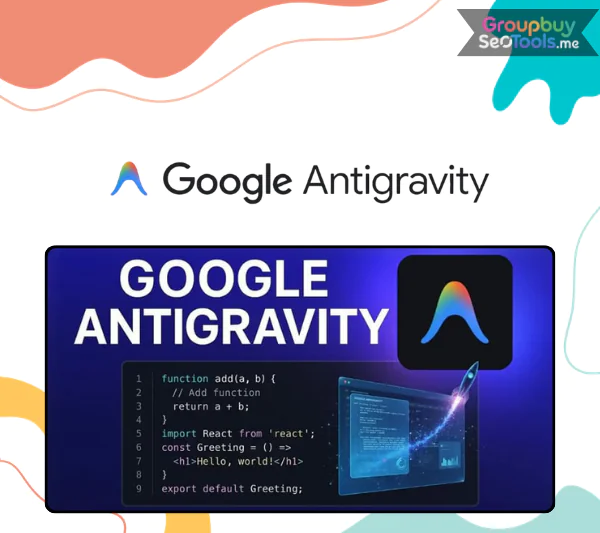
Conceptual interface of Google AntiGravity, an experimental agent-based AI development framework
Google AntiGravity signals a strategic evolution in how artificial intelligence participates in software and workflow management. This framework goes beyond predictive suggestions and into the world of autonomous task ownership. It was created as part of Google DeepMind’s larger research direction.
Google AntiGravity adds AI agents that can plan, execute, validate, and give full outputs instead of being a reactive assistant that waits for commands. The goal of these agents is to complete complicated, multi-step tasks while people watch over them.
This method is different because its parts work together very well. It has a real browser that lets agents see live web context and check results directly, an interactive editor that lets managers keep an eye on everything, and a central Agent Manager that helps manage multiple agents. All of these parts work together to make a setting that is cohesive and focused on execution.
Features of Google AntiGravity
Google AntiGravity illustrating autonomous AI agents operating within a unified workflow
The structure of Google AntiGravity is not like a simple chatbot on top of programming tools. Its design focuses on structured output and independent execution. The following are the things that make it unique:
Framework Based on Agents: The system is made up of autonomous AI agents instead of ideas that are based on prompts. Each worker can come up with a plan, carry it out, and then send back the finished results for a person to look over. This turns AI from a passive helper into an active addition to operations.
All-in-One Development Workspace: Coding, planning, running, and checking all happen in the same area. It cuts down on context switching and improves workflow continuity by lowering the number of scattered tools.
Centralized Agent Manager: Users can set up and manage many bots at the same time. Each agent can focus on different tasks, like fixing bugs, adding features, or going over documentation. This creates a system that’s similar to managing a technical team that works in different places.
Authentic Browser Interaction: Agents work in a real browser setting instead of simulating web activities. They can move through screens, interact with elements, submit forms, and check results visually, which makes testing more realistic.
Structured Output Artifacts: Outputs are more than just raw code. The system makes visual confirmations, change summaries, action roadmaps, and validation reports. The review process is more reliable and open because of these records.
Parallelized Task Execution: More than one worker can work at the same time. One might add new features while another runs automatic tests and a third looks over the documentation that goes with them. This concurrent workflow speeds up the creation process.
Integrated testing and automation: Agents can install dependencies, run commands, compile builds, and run automatic tests on their own. This feature helps the whole lifecycle, from making the product to making sure it works.
Flexible AI Model Selection: Depending on the task, different models can be used, such as those that require a lot of reasoning, structured coding, or processes that use a lot of logic. This flexibility gives you more precise control over how AI is used.
Multi-Platform Compatibility: Google AntiGravity is designed to work on all major operating systems, so it can be used by anyone, no matter what development platform they prefer.
Why Google AntiGravity Matters
When looking at the bigger picture, Google AntiGravity is a move away from AI-assisted editing and toward AI-coordinated action. Instead of helping writers write individual lines of code, it lets smart agents take on some of the responsibility for important development tasks.
This method makes operations more efficient in SEO-driven settings where technology changes, automation, testing, and validation need to happen quickly and correctly. Teams can cut down on bottlenecks and focus on making strategic choices instead of repetitive implementation details when they combine structured oversight with self-directed execution.
Access through GroupbuySeoTools is a useful way for professionals interested in advanced AI-driven workflows to try out new systems without having to pay full-scale business costs. Additionally, Google AntiGravity is not just a test interface; it’s part of a larger move toward agent-based development environments, in which AI actively plans, builds, and tests digital solutions.
Pricing plans
Google showcases future-focused technology concepts.
Plan
Availability
Price
Notes
Individual plan
Public preview
$0 / month
Free plan for individual builders
Developer plan
Recommended
Included with Google One (AI Pro or Ultra)
Price depends on Google One subscription
Team plan
Preview
Included with Google Workspace AI Ultra for Business
Higher rate limits for teams
Organization plan
Coming soon
Not announced
Enterprise-grade solution via Google Cloud
GroupbuySeoTools is a cheap way to get Google AntiGravity if you don’t know how much the official membership costs or just want to try it out before paying full price. When compared to standard plans, this platform gives you access to Google AntiGravity for about $40 a year, which is a much more affordable choice.
Why Choose Google AntiGravity via GroupbuySeoTools?
Reliability and openness are important when looking at third-party access companies. This is why a lot of people think GroupbuySeoTools is a better option:
Reliable and ready-to-use accounts: All accounts are carefully checked before they are sent out to make sure they are stable and can be used right away without having to go through a lot of setup.
Prices that are clear and reasonable: The one-time fee is about $40, and there are no extra or secret service fees.
Easy way to pay: You can use Internet Banking, which makes transfers quick and easy.
7-day money-back guarantee: You have seven days to ask for a refund if the service doesn’t live up to your hopes.
Help at any time: Customer service is open 24 hours a day, seven days a week to fix technology problems and answer questions before you buy.
How to Purchase Google AntiGravity at GroupbuySeoTools
Step 1: Select the Appropriate Package
Browse available Google AntiGravity options and choose the plan that matches your needs. Add the selected package to your cart.
Step 2: Review Your Order
Double-check plan details, pricing, and account information before moving forward. Careful confirmation helps avoid mistakes.
Step 3: Complete Payment
Proceed with Internet Banking and provide an accurate email address. This ensures you receive login credentials without delay.
Step 4: Receive Access and Start Using
Once payment is confirmed, account details and activation instructions will be delivered via email. You can begin using Google AntiGravity immediately.
How to use AntiGravity
Google Antigravity is an “agent-first” Integrated Development Environment (IDE) that uses autonomous AI agents to plan, code, and test applications.
Setup:
Download: Get the installer for Windows (10+), macOS (10.15+), or Linux (Ubuntu 20.04+) from the official download page.
Sign In: You must use a personal Gmail account; Google Workspace accounts are not currently supported during the public preview.
Inline AI: Press Cmd + I (Mac) or Ctrl + I (Windows) to open a text box at your cursor and give natural language instructions (e.g., “Add error handling to this function”).
Agent Manager: Open this surface via Cmd + E to manage multiple autonomous agents working across different codebases.
Operating Modes:
Fast Mode: For quick, low-complexity tasks like renaming variables or fixing typos.
Planning Mode: For complex tasks (e.g., building a new feature). The agent creates an Implementation Plan Artifact for you to review before it executes the code.
Key Strengths of Google AntiGravity
AntiGravity from Google stands out because it’s not just another AI bot. It works as a processing engine that connects different Google Cloud services to run complicated, multi-step processes.
Deep interaction with Google Cloud infrastructure: AntiGravity is made up of parts like Pub/Sub, Workflows, Cloud Run, and Vertex AI, which make it possible for services to work together without any problems. Tasks can set off events, divide up work among agents, and grow on their own without the need for fragile custom interfaces.
Guardrails and compliance controls that are built in make it easier to set up input validation, output filtering, and safety limits. This is especially helpful when dealing with sensitive data or in places that are controlled by rules.
Knowledge integration for grounded reasoning: Agents can use internal data, repositories, and knowledge bases as sources. This grounding makes hallucinations a lot less common and makes code ideas, analysis, and debugging insights more accurate.
Monitoring and observability that cover a lot of ground: built-in logging, tracking, and monitoring tools let you see how agents work. Developers don’t have to guess when problems happen when they can look at processes.
Limitations to Consider
Even though Google AntiGravity has some good points, it is not a light option. Before accepting it, you need to know what the downsides are.
Operational complexity: Setting up AntiGravity requires organizing a lot of different cloud parts. This system might seem too complicated for small projects when compared to AI tools that are easier to use.
Needs for cost management: Costs depend on how much is used, how much equipment is used, and how much data is transferred. Costs can rise faster than planned if there aren’t budget alerts and checks.
Dependence on a platform: The Google Cloud environment is very important to its efficiency. Migrating away later might need a lot of changes to be made.
Learning curve: To use it well, you need to know about cloud design, agent orchestration, and prompt structuring. It’s not a robot that you can just plug in and use; it’s a system that needs to be carefully set up.
Who Is Google AntiGravity Best For?
Google AntiGravity is not meant to be used for idle testing. When used in organized, production-level settings, it gives the most value.
AI product engineering teams are working on fully or partially autonomous systems that need to be planned, carried out, and improved over time.
Startups that deal with complicated robotic workflows: Coordinated agent execution can help products that generate code, test it, set up deployment processes, and keep an eye on things.
Businesses that already use Google Cloud: Businesses that use Vertex AI, Cloud Run, or similar services will find it easier to integrate and more productive.
Developers who want to be able to see and control how tasks are organized and how agents act instead of depending on AI responses that are hard to understand.
Compliance-focused teams work on projects that need to be governed, follow policies, keep audit logs, and be dependable in their operations.
Frequently Asked Questions About Google AntiGravity
Can AntiGravity independently execute code and validate results?
Yes. Agents can carry out commands, tests, look at outputs, and check the integrity of builds, which makes assumptions less important.
Does it reduce AI hallucinations?
Yes. Agents can use internal documents and databases to back up their answers, so they are based on real facts, which makes them more reliable.
Is advanced prompt engineering required?
You don’t have to be an expert to get good results, but clearly defining tasks and using organized communication do help a lot.
What outputs can it generate?
It can make structured plans, logs, execution summaries, validation reports, and findings that can be viewed in a browser, in addition to code.
Is Google AntiGravity free?
Previews and basic access may be limited, but full features rely on paid plans and how much cloud resource is used.
Is it better for individuals or teams?
AntiGravity can be used by writers working alone, but it works best in groups where many agents are working together to complete complicated tasks.
Final Thoughts
At the moment, Google AntiGravity works best as a framework for action rather than a full-on strategy planner. If you already have clear goals or ordered breakdowns of tasks, it works really well for putting those plans into action. But it might not be able to fully replace high-level planning workers until it is improved even more.
Professionals who want to check out what it can do without having to pay the high government rates can buy access through GroupbuySeoTools at a low cost. This method lets you check how well it works, how well it fits with your workflow, and how valuable it will be in the long run before you commit to bigger infrastructure expenses.
 Google
 Microsoft
 Adobe
Adobe Canva
Canva Kaspersky