 Google
 Microsoft
 Adobe
Adobe Canva
Canva Kaspersky
RankingGap
$102.00

$102.00
Sent via customer’s email
12-24hrs
All-in-one Subscription
RankingGap: Compare 4 competitor domains side-by-side, hijack high-ROI traffic, and scale organic search visibility fast.
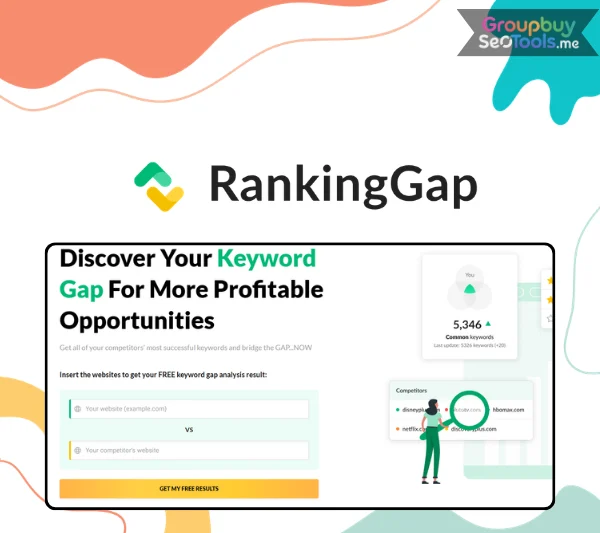
When users search for “RankingGap”, they usually have one of two goals in mind. Some want direct access to the SEO platform available at rankinggap.com, while others aim to understand the broader SEO methodology called ranking gap analysis. In both cases, the underlying issue is consistent: competitors are securing rankings for search terms that your website either ignores or ranks poorly for.
With over a decade of experience in building digital tools and SEO solutions, RankingGap helps marketers uncover these overlooked keyword opportunities. By transforming competitor data into actionable workflows, teams can convert gaps into measurable search traffic.
Whether you’re an SEO consultant managing multiple clients, a marketing specialist trying to outperform established brands, or a startup founder aiming to build authority in your niche, mastering ranking gap analysis can significantly enhance your organic visibility.
In this comprehensive guide, you will explore:
RankingGap is an SEO intelligence platform built to detect keyword and ranking gaps between your website and competitors. By comparing your domain against multiple competing sites, it highlights the terms your competitors rank for that your website is underperforming on—or missing entirely.
The workflow is intentionally straightforward. Start by entering your primary website and adding competitor domains. Competitors can either be manually input or suggested automatically based on overlapping keywords. Next, select the geographic region you want to analyze, such as a country or local market.
After processing, RankingGap delivers detailed reports showing exactly where competitor domains outperform your website in search results.
All data is presented in a clean table format, with each column representing a domain and rows showing keyword rankings. For instance, a competitor might rank third for “best CRM for freelancers”. If your website has no optimized content for that phrase, RankingGap flags it as a high-priority opportunity.
Unlike all-in-one SEO suites, RankingGap focuses on a single goal: helping marketers identify and close competitive gaps strategically. Many professionals use it alongside major SEO platforms to gain deeper insights and make smarter content decisions.
Competitor keyword analysis often uncovers opportunities traditional research misses. Across many industries, examining competitor rankings can reveal an additional 20%–50% of relevant keywords that were previously overlooked.
This works because when competitors produce content that ranks, they validate the demand for those terms. Their successful pages serve as a blueprint to expand your own content strategy.
Businesses that systematically identify and address ranking gaps usually see tangible improvements in search traffic.
For example, a SaaS company discovering 150 untapped keywords generating 8,000 monthly searches could potentially gain ~1,600 new visitors per month at a 20% click-through rate. These visitors typically have high commercial intent, improving the likelihood of conversion.
Of course, identifying keyword gaps alone doesn’t guarantee rankings. Quality content, website authority, and meeting user intent remain critical. Recognizing the types of ranking gaps helps prioritize efforts that will deliver the highest impact.
Topical authority reflects how deeply a website covers a subject. Modern search algorithms favor comprehensive, interconnected content over isolated posts.
Keyword gap analysis helps build this authority by revealing subtopics competitors cover that your website lacks, avoiding the trap of publishing only a few broad articles without supporting content.
Closing gaps strengthens E-E-A-T signals:
For example, creating tutorials, case studies, and implementation guides on email marketing automation strengthens primary product pages targeting email marketing software keywords. RankingGap shows where opportunities exist, but execution quality determines competitive success.

| Gap Type | Description | Typical Sign | Example | Detection Method |
|---|---|---|---|---|
| Missing Keywords | Competitors rank; your site has no content targeting the query | No search impressions | Competitor ranks for “project management templates” while your site has no page | Competitor-only keyword filters |
| Position Gaps | Your pages rank lower than competitors | Lower average positions | Your page ranks #15 while competitor is #3 | Ranking comparison reports |
| Content Depth Gaps | Existing pages lack sufficient detail | Higher bounce rate, lower engagement | 500-word guide versus competitor’s 2,000-word article | SERP and content analysis |
| SERP Feature Gaps | Competitors appear in rich results your pages miss | No featured snippets or enhanced listings | Competitor owns snippet for ROI calculation | SERP feature tracking |
| Topical Coverage Gaps | Whole topic clusters are missing | Limited coverage | Competitor publishes dozens of email marketing guides | Topic cluster analysis |
| Freshness Gaps | Competitor pages are more recent | Older pages decline in rankings | Your article cites outdated statistics | Content audits |
These occur when competitors rank for queries your website doesn’t target at all. These are often the quickest opportunities to grow organic traffic. Causes include:
High-value gaps typically appear in:
Example: A project management software company may find competitors ranking for “team collaboration tools” or “project timeline software”. Publishing optimized content targeting these keywords can capture traffic quickly.
These occur when both your site and competitors rank for a keyword, but your site appears lower. Addressing position gaps usually involves optimizing existing content rather than creating new pages. Common causes include stronger competitor content, technical SEO advantages, and better user experience.
Pages may target the right keyword but fail to satisfy user intent due to inadequate depth or structure. Examples include:
Key missing elements often include step-by-step instructions, pricing comparisons, case studies, FAQs, and visual assets like images or videos. Studying top search results helps determine what users expect.
SERP feature gaps occur when competitors dominate enhanced search results while your content remains in standard listings—or doesn’t appear at all. These results draw more attention due to their prominent positioning.
When combined with keyword and competitive gap analysis, targeting SERP features provides a holistic view of growth opportunities. RankingGap simplifies this by highlighting where competitors currently dominate and where you can strategically expand visibility.
RankingGap offers flexible pricing plans to match different business needs, whether you are an individual marketer, growing business, or an agency managing multiple clients. Here’s a breakdown of what each plan includes:
| Feature | Basic (Annual) | Premium (Annual) | Agency (Annual) |
| Monthly Cost | $25 (Save $58) | $41 (Save $98) | $50 (Save $118) |
| Annual Billing | $290 | $490 | $590 |
| Active Projects Allowed | 20 projects | 100 projects | Unlimited projects |
| Website Comparison Limit | Up to 5 sites | Up to 5 sites | Up to 5 sites |
| Export Credits / Month | 10,000 rows | 40,000 rows | 50,000 rows |
| Competitor Discovery Credits | 1,000 | 2,500 | 5,000 |
| Project Tag Capacity | 5 tags | 20 tags | Unlimited tags |
RankingGap provides detailed insights into how keywords perform across your domain and your competitors. Each plan offers access to multiple types of keyword visibility metrics.
| Feature | Basic | Premium | Agency |
| Shared Keywords | ✓ | ✓ | ✓ |
| Missing Keywords | ✓ | ✓ | ✓ |
| Keyword Opportunities | ✓ | ✓ | ✓ |
| Unique Keyword Insights | ✓ | ✓ | ✓ |
| Starred Keyword Tracking | ✓ | ✓ | ✓ |
All plans provide access to essential keyword data that supports strategic decision-making for SEO campaigns.
| Feature | Basic | Premium | Agency |
| Search Volume Data | ✓ | ✓ | ✓ |
| Historical Search Trends | ✓ | ✓ | ✓ |
| Cost Per Click (CPC) | ✓ | ✓ | ✓ |
| Competition Metrics | ✓ | ✓ | ✓ |
| SERP Feature Tracking | ✓ | ✓ | ✓ |
These capabilities allow you to closely monitor competitor rankings and uncover opportunities that may have been overlooked.
| Feature | Basic | Premium | Agency |
| Discover Hidden Rankings | ✓ | ✓ | ✓ |
| Monitor Competitor Positions | ✓ | ✓ | ✓ |
| Identify URLs Driving Rankings | ✓ | ✓ | ✓ |
| View Page Titles in Rankings | ✓ | ✓ | ✓ |
| Exact URL Comparison | ✓ | ✓ | ✓ |
| Analyze Page Overlaps | ✓ | ✓ | ✓ |
| Feature | Basic | Premium | Agency |
| Competitor Profile Insights | ✓ | ✓ | ✓ |
| Traffic Estimates | ✓ | ✓ | ✓ |
| Keyword Overlap Analysis | ✓ | ✓ | ✓ |
| Track Keywords on First Page | ✓ | ✓ | ✓ |
| Performance Visualization | ✓ | ✓ | ✓ |
| Feature | Basic | Premium | Agency |
| Tag Projects for Organization | ✓ | ✓ | ✓ |
| Export Data to CSV | ✓ | ✓ | ✓ |
| Monitor Favorite Keywords | ✓ | ✓ | ✓ |
| Support Across 100+ Countries | ✓ | ✓ | ✓ |
| 35+ Language Options | ✓ | ✓ | ✓ |
Getting started with RankingGap is designed to be intuitive. The platform walks you through setting up your domain, adding competitors, and preparing for in-depth keyword analysis.
Step-by-step guide:
Selecting the right competitors:
Once setup is complete, RankingGap delivers reports with current rankings, search volume, keyword difficulty, and potential traffic. Integration with Google Search Console enhances accuracy by combining competitor insights with real performance data.
Visualizations of keyword gaps and competitor benchmarks help identify opportunities for maximum search visibility. Including authoritative competitors sets a standard for quality and performance goals.
Targeting only high-volume search terms can be misleading. While attractive, these keywords are highly competitive and may delay tangible results.
Why this approach can backfire:
Benefits of including long-tail keywords:
Example: Instead of just “email marketing software,” focus on:
Gathering data without action limits impact. Competitor insights are only valuable when applied to content or optimization strategies.
Best practices:
Desktop rankings alone don’t reflect the full search landscape. Mobile, local searches, and SERP features can significantly change visibility.
Considerations:
Best practices:
| Time | 1 Year |
|---|
There are no reviews yet.