 Google
 Microsoft
 Adobe
Adobe Canva
Canva Kaspersky
Seller Snap
$102.00

$102.00
Sent via customer’s email
12-24hrs
All-in-one Subscription
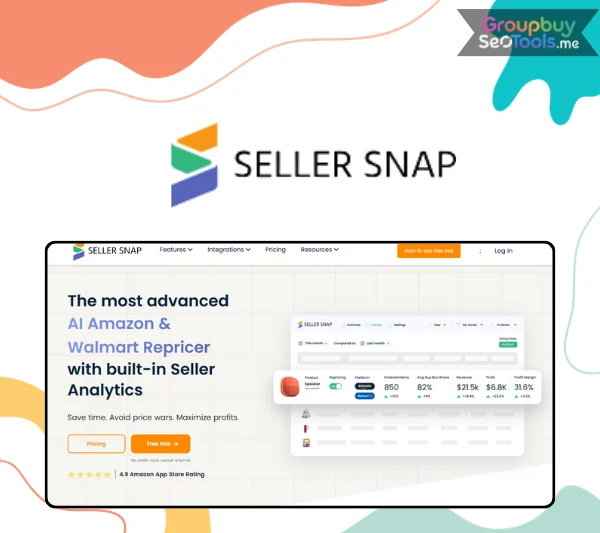
Seller Snap: Automate smart repricing, avoid destructive price wars, and protect your FBA Amazon margins effortlessly.
Rule-based repricers have a fundamental flaw baked into their design. They respond to price changes but can’t predict them. They match the lowest price but can’t recognize when holding a higher price is actually the smarter move. They compete — always, reflexively, without judgment — and the result is the race to zero that every Amazon seller running a conventional repricer knows intimately.
Seller Snap was built around a different premise. Pricing on Amazon isn’t a one-player optimization problem. It’s a multi-player strategic game, and the best move depends on what every other player is doing and what they’re likely to do next. That’s not a metaphor — it’s the literal application of Game Theory, the mathematical framework for strategic decision-making between multiple rational actors. Seller Snap applies it to every pricing decision across every SKU in your catalog, every one to two minutes.
The outcome that users consistently report: Seller Snap raises prices more often than it lowers them, while improving or maintaining Buy Box percentage. According to the company’s internal data, sellers who used the platform for a full year grew their Amazon profit by an average of 23%. Cajua Robinson of Ecom Unlimited credited Seller Snap with helping achieve their first million-dollar revenue year on Amazon. Thomas Parkinson of Fast Track FBA specifically called out the platform’s habit of raising prices strategically rather than crashing them.
Seller Snap is an Amazon Selling Partner Appstore-approved tool, a Walmart Partner, and holds a 4.9-star rating on the Amazon App Store.
Seller Snap is a premium tool with premium pricing. The user base it serves best:
One seller review tells the story plainly: after switching to Seller Snap, weekly sales jumped from £1,000 to £10,000 within two weeks — with no changes to the product catalog. The improvement came entirely from repricing strategy.
It’s equally worth saying who it’s not built for. Sellers under $5,000/month in revenue, those with fewer than 100 SKUs, or those selling entirely unique private label products with no Buy Box competition will find the price hard to justify. BQool or Amazon’s free Automate Pricing tool are better starting points at that stage.
The conceptual distinction matters because it explains why Seller Snap behaves so differently from tools that technically do the same thing.
A rule-based repricer executes instructions. “If I am not in the Buy Box, lower price by $0.01.” It is deterministic, predictable, and incapable of anything not in its ruleset. It cannot detect that a competitor is about to stabilize their price. It cannot recognize that both you and your competitor would be better off holding a higher price. It only knows one move: down.
Game Theory repricing models competitors as strategic players. Seller Snap categorizes each competitor on a listing into behavioral types: stable sellers who hold prices, reactive sellers who mirror cuts, and aggressive undercutters who will race to the floor regardless. For stable competitors, it looks for the cooperative equilibrium — the price point where both sellers hold higher prices because defecting (undercutting) produces a worse outcome for everyone. When that equilibrium exists, Seller Snap holds or raises prices to find it. When a competitor is genuinely aggressive, it competes directly while keeping the floor intact.
This is why Seller Snap raises prices. Not because it ignores competition, but because it recognizes that competition doesn’t always require a lower price to win.
The flagship capability. The AI processes pricing decisions across the full catalog every one to two minutes — significantly faster than the 15-minute cycle of most rule-based tools. In high-velocity categories like electronics, toys, health products, and supplements, this speed difference translates directly into more Buy Box time.
The Auto-adjust feature handles structural changes automatically: a competitor going out of stock, a new seller entering a listing, a competitor’s price spiking. Each triggers a recalibration to capture the resulting opportunity without manual intervention.
Beyond the AI mode, Seller Snap’s strategy builder allows sellers to define rules and conditional logic for specific situations:
Strategies can be applied per SKU, per product group, or globally, and can switch automatically based on inventory level, sales velocity, or competitive triggers.
Seller Snap pulls actual FBA fee data from Amazon and combines it with your cost-of-goods inputs to calculate the minimum profitable price for each SKU automatically. This eliminates the most dangerous mistake in repricer setup: manually estimating price floors without accounting for all fee components, which causes the repricer to price listings into unprofitable territory.
Seller Analytics shows revenue, net profit, Buy Box share percentage, sales velocity, and competitor price history per SKU. DataHub aggregates across the full catalog to surface profitability trends, margin compression patterns, and competitive landscape shifts — including windows where a competitor going out of stock or raising prices creates a temporary opportunity to capture higher-margin Buy Box share.
For agencies managing multiple seller accounts, DataHub provides a cross-account view for portfolio-level analysis. Premium and Custom plans include dedicated account management and expanded data access.
Launched in late 2025, Seller Snap’s Walmart repricer extends the same AI Game Theory engine to Walmart Marketplace and is included on all plans. For Amazon sellers adding Walmart, this eliminates the cost and complexity of a second repricing tool subscription.
Seller Snap connects to InventoryLab, SkuVault, Sellercloud, ScanPower, EzCloud, and Boxem — the most commonly used inventory management, accounting, and warehouse tools in the FBA seller stack.
| Feature | Starter 🆕 | Accelerator | Standard | Custom |
| Price (Annual Billing) | $100/month | $250 $175/month | $500 $425/month | Custom Pricing |
| Annual Savings | Save 30% | Save $900/year | Save $900/year | Custom |
| Marketplace / Seller IDs | 1 Marketplace | 1 Seller ID | 1 Seller ID | Customized |
| Users | 1 User | 3 Users | 3 Users | Customized |
| SKU Count | 1,000 SKUs | 1,000 SKUs | 15,000 SKUs | Customized |
| Revenue Limit | $15,000 | $30,000 | Unlimited | Customized |
| Amazon Support | ✔️ | ✔️ | ✔️ | ✔️ |
| Walmart Support | ✔️ | ✔️ | ✔️ | ✔️ |
| AI Repricing Technology | ✔️ | ✔️ | ✔️ | ✔️ |
| Min & Max Price Calculation | ✔️ | ✔️ | ✔️ | ✔️ |
| Analytics | ✔️ | ✔️ | ✔️ | ✔️ |
| Connectivity | ✔️ | ✔️ | ✔️ | ✔️ |
| Integrations | ✔️ | ✔️ | ✔️ | ✔️ |
| Capability | Starter | Accelerator | Standard | Custom |
| Amazon Marketplace Support | ✔️ | ✔️ | ✔️ | ✔️ |
| Walmart Marketplace Support | ✔️ | ✔️ | ✔️ | ✔️ |
| AI-Powered Repricing | ✔️ | ✔️ | ✔️ | ✔️ |
| Automated Min/Max Pricing | ✔️ | ✔️ | ✔️ | ✔️ |
| Analytics Dashboard | ✔️ | ✔️ | ✔️ | ✔️ |
| Marketplace Connectivity | ✔️ | ✔️ | ✔️ | ✔️ |
| Third-Party Integrations | ✔️ | ✔️ | ✔️ | ✔️ |
| Business Type | Recommended Plan |
| New marketplace sellers with limited inventory and revenue | Starter ($100/month) |
| Growing Amazon/Walmart sellers managing up to $30,000 revenue | Accelerator ($175/month) |
| Established sellers with large catalogs and unlimited revenue needs | Standard ($425/month) |
| Enterprises with multiple accounts, large teams, or custom requirements | Custom |
| Metric | Starter → Accelerator | Accelerator → Standard |
| Monthly Price | +$75 | +$250 |
| Users | 1 → 3 | No change |
| Revenue Limit | $15K → $30K | $30K → Unlimited |
| SKU Count | No change (1,000) | 1,000 → 15,000 |
| Scalability | Small sellers | Growing businesses → Large-scale operations |
| Tool | Approach | Speed | Starting Price | Best For |
| Seller Snap | AI Game Theory | 1–2 min | $100/mo | High-volume wholesale, agencies, multi-channel |
| Aura | Machine learning | 1–2 min | $27/mo | FBA sellers wanting speed at lower cost |
| BQool | AI + rule hybrid | 15 min | $25/mo | Budget-conscious and beginner sellers |
| Repricer.com | Rule + AI, fast | Sub-15 sec | $79/mo | Sellers needing absolute maximum speed |
| Informed.co | Data-first | Minutes | $99/mo | Analytics-focused and enterprise sellers |
| Amazon Automate Pricing | Rule-based (free) | Hours | Free | Brand-new sellers learning repricing basics |
The honest framing: Aura is the most credible lower-cost alternative for sellers who want fast, intelligent repricing without the Game Theory sophistication. BQool is appropriate for sellers under $5,000/month. Repricer.com wins on raw speed for ultra-competitive categories. Seller Snap wins on strategic margin protection — the ability to raise prices, not just compete for the lowest one.
Is Seller Snap free?
No permanent free plan. The 15-day free trial includes full feature access — no credit card, no contract. Paid plans start at $100/month for Starter on annual billing.
How is Game Theory repricing different from rule-based?
Rule-based repricers execute fixed instructions and always chase the lowest price. Game Theory repricing models each competitor as a strategic player, identifies when a higher-price equilibrium is achievable, and holds or raises prices when it is. The practical result: Seller Snap raises prices in stable competitive conditions instead of defaulting to the floor.
Does it work for private label sellers?
Yes, with context. Private label sellers facing hijackers or unauthorized resellers benefit from the margin-protection strategies and automated competitive response. Sellers with listings where nobody else competes for the Buy Box get minimal value from the AI repricing specifically — though Seller Analytics remains useful regardless.
Which marketplaces are supported?
All 21 Amazon global marketplaces plus Walmart Marketplace. All are managed from one dashboard. Walmart support is included on every plan at no additional cost.
Can teams and agencies use it?
Accelerator and Standard support 3 users and 1 Seller ID. Custom plans support multiple seller accounts, unlimited users, and organizational access controls. DataHub provides cross-account analytics for agency portfolio management.
What integrations are available?
InventoryLab, SkuVault, Sellercloud, ScanPower, EzCloud, and Boxem.
What are the main limitations?
Standard plan pricing at $425/month is prohibitive for smaller sellers. The strategy depth requires active engagement to extract full value. Large catalog sellers and agencies managing multiple accounts should request Custom pricing rather than assuming Standard limits will hold.
| Time | 1 Year |
|---|
There are no reviews yet.